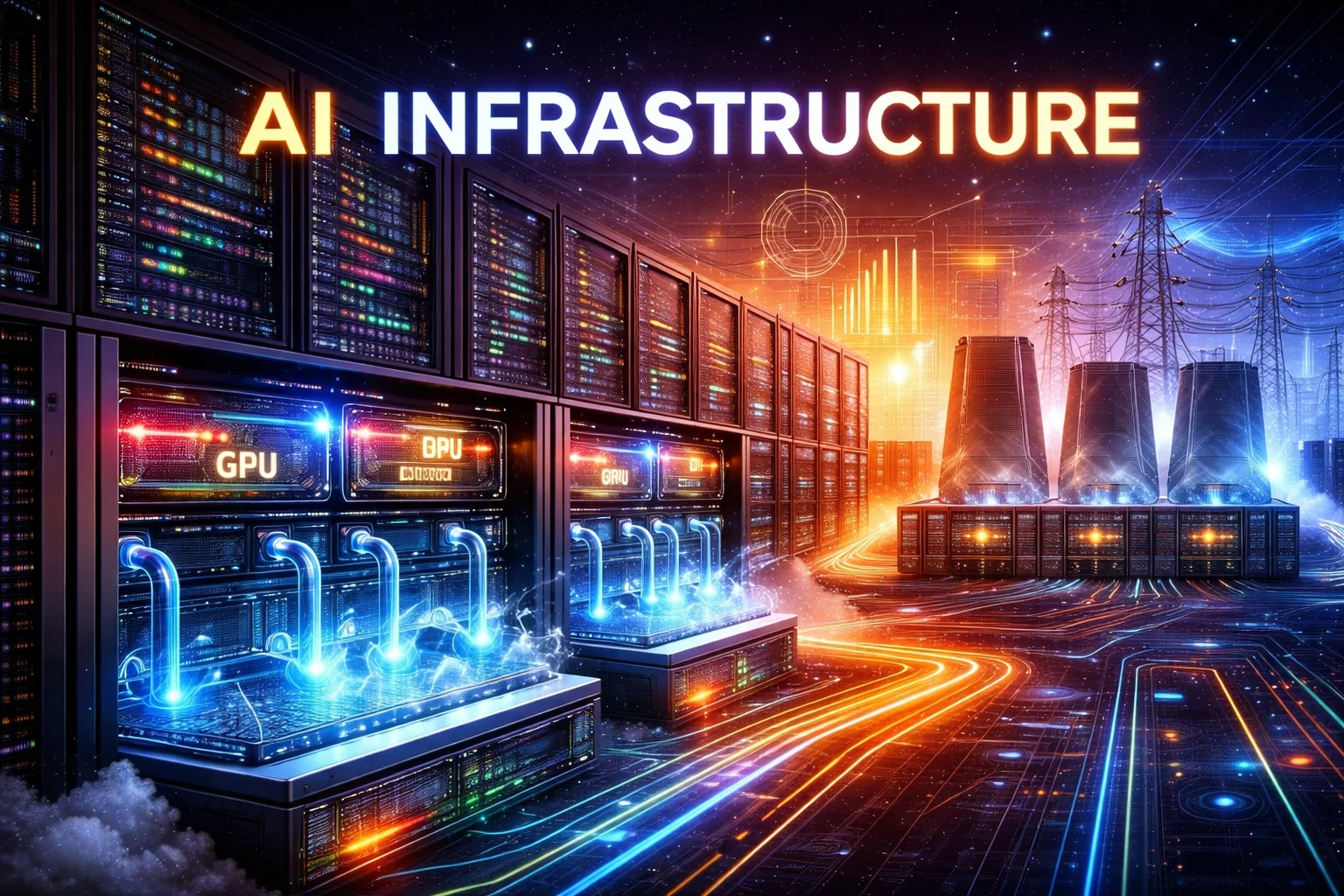
Inside the AI Infrastructure Boom: GPUs, Power, Cooling, and the New Bottlenecks
Introduction: The Infrastructure Revolution Behind AI's Rise
The artificial intelligence infrastructure boom represents one of the most significant shifts in computing architecture since the transition from mainframes to distributed systems. As organizations worldwide deploy increasingly sophisticated AI models, from large language models to computer vision systems, the underlying infrastructure requirements have fundamentally changed the landscape of high-performance computing and data center operations.
This transformation extends far beyond simply adding more graphics processing units (GPUs) to existing server racks. The AI infrastructure boom has created entirely new categories of bottlenecks, power consumption patterns, and cooling challenges that infrastructure engineers must navigate. Understanding these changes is crucial for anyone involved in planning, deploying, or managing computing infrastructure that supports AI workloads.
The implications reach into every aspect of data center design, from electrical grid planning to network topologies, and have created supply chain pressures that affect procurement strategies across the industry. For infrastructure teams, the question isn't whether AI will impact their operations, but how quickly they can adapt their systems to support these demanding new workloads while maintaining reliability and cost-effectiveness.
What Is the AI Infrastructure Boom?
The AI infrastructure boom refers to the massive scaling of specialized computing resources designed to support artificial intelligence workloads, particularly the training and inference of large neural networks. This phenomenon encompasses the rapid deployment of GPU-accelerated computing clusters, the development of AI-specific data center designs, and the emergence of new bottlenecks in power delivery, cooling, and interconnect technologies.
At its core, this boom represents a shift from traditional CPU-centric computing to accelerated computing architectures optimized for the parallel processing requirements of AI algorithms. Unlike conventional enterprise workloads that rely primarily on central processing units and standard memory hierarchies, AI workloads demand massive parallel computation capabilities, high-bandwidth memory systems, and low-latency interconnects between processing units.
The scale of this transformation is unprecedented. A single AI training cluster can consume as much power as a small city, with individual servers drawing 10-20 times more electricity than traditional enterprise servers. These systems generate correspondingly massive amounts of heat, requiring cooling solutions that go far beyond conventional air conditioning systems.
This infrastructure boom has also created new economic models around computing resources. Organizations are building dedicated AI data centers, cloud providers are developing AI-specific instance types, and entirely new categories of infrastructure-as-a-service offerings have emerged to meet the demand for AI compute capacity.
How AI Infrastructure Works
AI infrastructure operates on fundamentally different principles than traditional computing infrastructure. The architecture centers around massively parallel processing capabilities, with thousands of specialized cores working simultaneously on different aspects of AI computations.
The foundation of modern AI infrastructure lies in graphics processing units, originally designed for rendering computer graphics but perfectly suited for the matrix operations that drive neural network computations. Modern AI GPUs contain thousands of small, efficient cores that can perform many calculations simultaneously, making them dramatically more effective than traditional CPUs for AI workloads.
Memory architecture plays a critical role in AI infrastructure performance. AI models, particularly large language models, can require hundreds of gigabytes or even terabytes of high-bandwidth memory. This memory must be accessible with minimal latency, as any delays in data access can bottleneck the entire computation. High-bandwidth memory technologies and advanced memory hierarchies have become essential components of AI infrastructure.
Interconnect technology forms another crucial element. AI training often requires coordination between hundreds or thousands of GPUs working on the same problem. These processors must exchange gradient updates, model parameters, and intermediate results with minimal latency. Advanced interconnect fabrics, including proprietary solutions and high-speed Ethernet implementations, have become critical for maintaining performance at scale.
Storage systems supporting AI infrastructure must handle unique access patterns. AI training involves reading massive datasets repeatedly, while inference workloads require rapid access to model parameters and input data. These requirements have driven the adoption of high-performance storage solutions, including NVMe-based systems and parallel file systems optimized for AI workflows.
Key Components and Architecture
Modern AI infrastructure architectures comprise several specialized components working together to deliver the performance and scale required for contemporary AI workloads.
Processing Units and Accelerators
The heart of AI infrastructure consists of specialized processing units designed for parallel computation. Graphics processing units remain the dominant technology, with offerings from major vendors providing thousands of cores capable of performing floating-point operations at tremendous rates. These GPUs often include specialized tensor processing units optimized specifically for the mathematical operations common in neural networks.
Application-specific integrated circuits represent another category of AI accelerators, designed from the ground up for specific AI workloads. These chips can offer superior performance per watt for particular use cases but typically provide less flexibility than general-purpose GPUs.
Field-programmable gate arrays offer a middle ground between flexibility and optimization, allowing organizations to customize hardware acceleration for specific AI algorithms while maintaining the ability to reconfigure the hardware for different workloads.
Memory and Storage Subsystems
AI infrastructure requires sophisticated memory hierarchies to feed data to processing units efficiently. High-bandwidth memory provides the rapid data access necessary for AI computations, while advanced caching strategies help manage the movement of data between different levels of the memory hierarchy.
Storage systems must balance capacity, performance, and cost while handling the unique access patterns of AI workloads. Training datasets can reach petabyte scales, requiring storage systems capable of delivering sustained high throughput to multiple processing nodes simultaneously.
Interconnect and Networking
High-performance interconnects enable the coordination required for distributed AI training. These systems must provide low latency and high bandwidth while scaling to thousands of connected processing units. Advanced topologies, including fat-tree and torus configurations, help maintain performance as systems scale.
Network-attached acceleration has emerged as a strategy for offloading certain AI computations to specialized network interface cards, reducing the load on primary processing units while maintaining high throughput.
Power and Cooling Infrastructure
The power requirements of AI infrastructure have driven innovations in electrical distribution and power management. High-density power delivery systems must provide clean, stable power to processing units that can draw hundreds of watts each while maintaining high efficiency to minimize heat generation.
Cooling systems represent one of the most challenging aspects of AI infrastructure design. Traditional air cooling struggles to handle the heat densities generated by modern AI hardware, leading to the adoption of liquid cooling solutions, including direct-to-chip cooling and immersion cooling technologies.
Use Cases and Applications
AI infrastructure supports a diverse range of applications, each with distinct requirements and performance characteristics that influence infrastructure design decisions.
Large Language Model Training and Inference
Training large language models represents one of the most demanding applications of AI infrastructure. These models can contain hundreds of billions or even trillions of parameters, requiring massive computational resources and sophisticated distributed training algorithms. The infrastructure must support months-long training runs while maintaining fault tolerance and checkpointing capabilities.
Inference deployment for large language models presents different challenges, emphasizing low latency and high throughput rather than pure computational scale. Infrastructure must be optimized for rapid response times while handling thousands of concurrent requests.
Computer Vision and Image Processing
Computer vision applications, including autonomous vehicle development, medical imaging, and manufacturing quality control, require infrastructure capable of processing high-resolution images and video streams in real-time. These workloads often combine training on massive image datasets with real-time inference requirements.
Scientific Computing and Simulation
AI infrastructure increasingly supports scientific applications, including climate modeling, drug discovery, and materials science. These applications often combine traditional high-performance computing workloads with AI-accelerated components, requiring hybrid infrastructure architectures.
Edge AI and Distributed Inference
The deployment of AI capabilities at network edges requires infrastructure designs that balance performance with power efficiency and physical constraints. Edge AI infrastructure must operate reliably in challenging environments while maintaining connectivity to centralized training and management systems.
Benefits and Challenges
The AI infrastructure boom brings significant advantages while creating new challenges that infrastructure teams must address.
Performance and Capability Benefits
AI infrastructure enables computational capabilities that were impossible with traditional computing architectures. The massive parallelism available through GPU acceleration allows organizations to train models and process data at scales that would be prohibitively expensive or time-consuming with conventional systems.
The specialized nature of AI hardware delivers superior performance per watt for AI workloads compared to general-purpose processors. This efficiency advantage becomes critical when operating at the scales required for modern AI applications.
Economic and Operational Advantages
Organizations can achieve better resource utilization through AI infrastructure, as the same hardware can support multiple AI workloads through containerization and orchestration technologies. The ability to share expensive AI infrastructure across multiple projects and teams helps justify the substantial capital investments required.
Cloud-based AI infrastructure services provide access to cutting-edge capabilities without the need for massive upfront investments, allowing organizations to experiment with AI technologies and scale resources based on actual demand.
Technical and Operational Challenges
Power consumption represents one of the most significant challenges in AI infrastructure deployment. The electrical demands of large AI systems can exceed the capacity of existing data centers, requiring substantial upgrades to power generation and distribution systems.
Cooling requirements present equally complex challenges. The heat densities generated by AI hardware often exceed the capabilities of traditional cooling systems, necessitating advanced liquid cooling technologies that require specialized expertise to deploy and maintain.
Supply chain constraints have created significant challenges in AI infrastructure procurement. High demand for AI-specific hardware has led to extended lead times and inflated prices, complicating infrastructure planning and budgeting processes.
Reliability and Maintenance Concerns
The complexity of AI infrastructure creates new categories of failure modes and maintenance requirements. The interdependencies between processing units, memory systems, and interconnects mean that component failures can have cascading effects across entire clusters.
The specialized nature of AI hardware often requires vendor-specific expertise for maintenance and troubleshooting, creating potential dependencies that may not exist with traditional infrastructure components.
Getting Started with AI Infrastructure Implementation
Organizations approaching AI infrastructure deployment should begin with a thorough assessment of their specific requirements and constraints, as the diversity of AI applications means that one-size-fits-all solutions rarely provide optimal results.
Requirements Assessment and Planning
Start by characterizing your AI workloads in terms of computational requirements, memory usage patterns, and performance objectives. Training workloads typically require sustained high-performance computing over extended periods, while inference applications prioritize low latency and high concurrency.
Evaluate your existing infrastructure capabilities, including power capacity, cooling systems, and network bandwidth. Many organizations discover that their current data center infrastructure requires significant upgrades to support AI workloads effectively.
Consider the total cost of ownership beyond initial hardware procurement. AI infrastructure often requires ongoing investments in power, cooling, and specialized support services that can significantly impact long-term operational costs.
Architecture Design and Component Selection
Design your AI infrastructure architecture around your specific workload requirements rather than simply scaling existing designs. Consider whether your applications require tightly coupled clusters for distributed training or can operate effectively with loosely coupled inference nodes.
Evaluate different processing unit options based on your specific algorithms and performance requirements. While GPUs dominate the AI acceleration market, alternative technologies may provide better performance or cost-effectiveness for particular use cases.
Plan for growth and flexibility in your infrastructure design. AI workloads and requirements continue to evolve rapidly, making adaptability a crucial consideration in infrastructure planning.
Implementation and Deployment Strategies
Consider phased deployment approaches that allow you to gain experience with AI infrastructure while minimizing risk. Starting with smaller clusters or cloud-based solutions can provide valuable insights before committing to large-scale on-premises deployments.
Invest in monitoring and management tools specifically designed for AI infrastructure. Traditional monitoring solutions may not provide the visibility needed to optimize performance and identify bottlenecks in AI workloads.
Develop operational procedures for AI infrastructure that account for the unique characteristics of these systems, including specialized backup and recovery procedures for large model checkpoints and strategies for handling the inevitable hardware failures in large-scale systems.
Skills Development and Team Preparation
Ensure your team has the necessary expertise to deploy and maintain AI infrastructure effectively. This often requires training in new technologies, vendor-specific tools, and specialized debugging techniques.
Establish relationships with vendors and service providers who can provide support during deployment and ongoing operations. The complexity of AI infrastructure often makes vendor partnerships essential for successful implementations.
Plan for ongoing education and skill development, as AI infrastructure technologies continue to evolve rapidly. Regular training and certification programs help ensure your team can adapt to new technologies and best practices.
Key Takeaways
• The AI infrastructure boom represents a fundamental shift from CPU-centric to accelerated computing architectures, requiring specialized knowledge and approaches to infrastructure design and management.
• Power consumption and cooling requirements for AI infrastructure far exceed traditional computing systems, often necessitating substantial upgrades to data center electrical and cooling infrastructure.
• GPU shortages and supply chain constraints make procurement planning critical, with lead times and costs significantly higher than traditional infrastructure components.
• Memory bandwidth and interconnect performance often become primary bottlenecks in AI infrastructure, requiring careful attention to memory hierarchy design and network topology optimization.
• Liquid cooling technologies are becoming essential for high-density AI deployments, representing a significant shift from traditional air cooling approaches in data center design.
• AI workloads exhibit unique performance characteristics that require specialized monitoring, management, and optimization approaches distinct from traditional enterprise applications.
• The total cost of ownership for AI infrastructure includes substantial ongoing operational expenses beyond initial hardware costs, particularly in power consumption and specialized support services.
• Organizations should start with thorough requirements assessment and consider phased deployment approaches to manage the complexity and costs associated with AI infrastructure implementation.
• Future developments in quantum computing acceleration and hybrid quantum-AI systems will likely create new categories of infrastructure requirements and optimization opportunities.
• Success with AI infrastructure requires investment in specialized skills and vendor relationships, as the complexity of these systems often exceeds traditional IT infrastructure management capabilities.