Summary
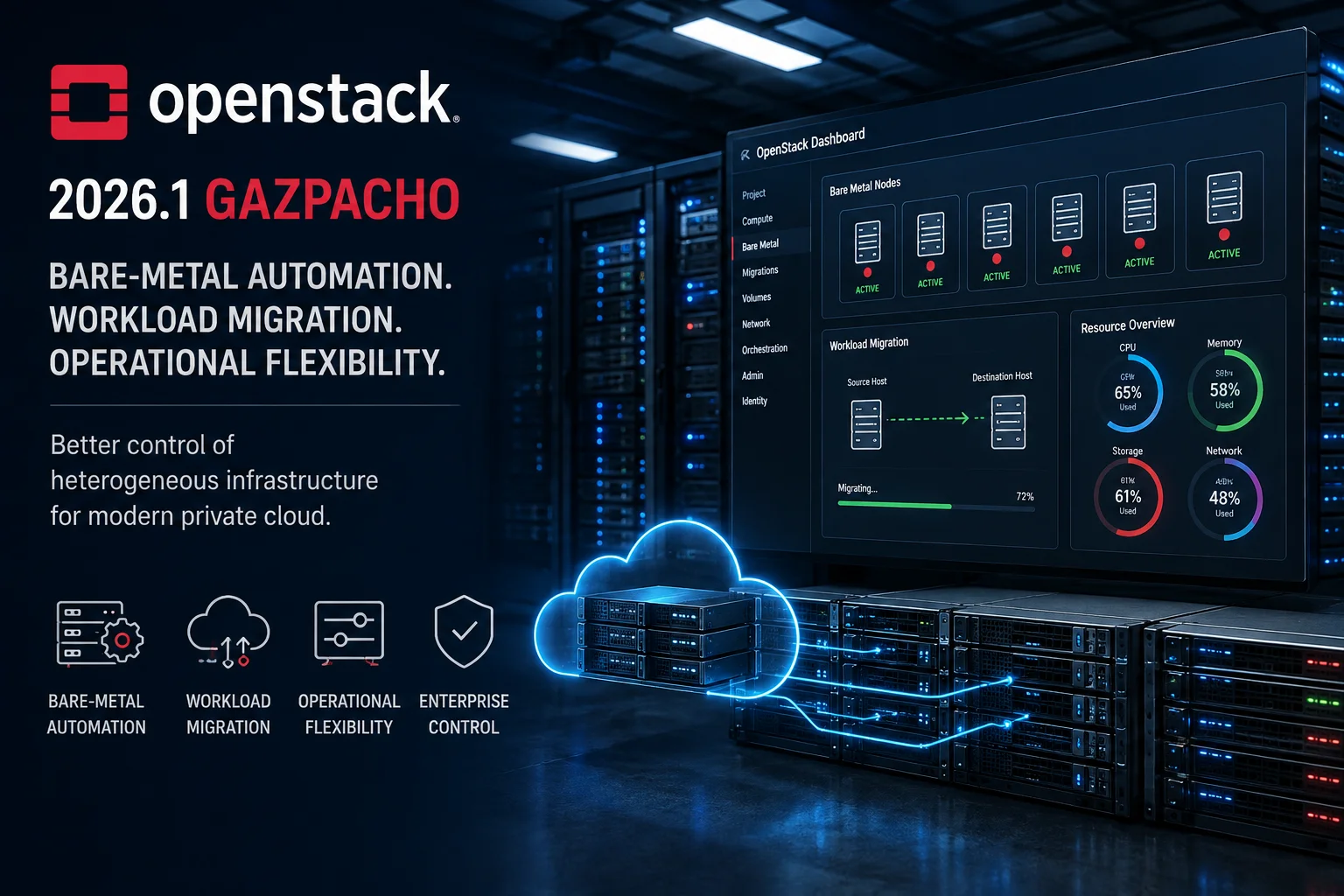
OpenStack 2026.1 “Gazpacho” is not a flashy release, but it is a useful signal for enterprise infrastructure teams that are reconsidering private cloud, bare-metal automation, and workload mobility. The release highlights operational improvements across OpenStack services, including Ironic bare-metal enhancements, Nova live migration with vTPM, Watcher cross-zone migration strategy testing, and continued maintenance across the broader ecosystem.
The angle that matters for infrastructure architects is straightforward: private cloud is becoming less about recreating public-cloud APIs and more about managing heterogeneous infrastructure with stronger automation and fewer manual operator decisions. For organizations running AI, HPC, regulated workloads, edge fleets, or VMware migration projects, the bare-metal and migration improvements are more important than another round of generic cloud messaging.
Why OpenStack still matters in 2026
OpenStack occupies a different position than it did during the first private-cloud wave. It is no longer treated as a universal replacement for every public-cloud service. Instead, it is often deployed where infrastructure ownership, hardware control, data locality, cost predictability, or workload mobility matter enough to justify operating a cloud platform directly.
That shift makes the 2026.1 Gazpacho release relevant even for organizations that are not planning a greenfield OpenStack deployment. The release reflects the kinds of requirements that now define private infrastructure: bare-metal provisioning for specialized servers, migration tools for sensitive workloads, stronger hardware enablement, and operational improvements that reduce manual decision-making.
The OpenStack project describes Gazpacho as the 33rd version of the platform and a SLURP release focused on workload migration and simplified cloud operations. The official release material points to almost 9,000 changes and more than 500 contributors. The raw numbers are less important than the direction. Mature infrastructure platforms win by removing friction from repetitive operator work, not by adding another abstraction layer for its own sake.
Bare metal is becoming a cloud primitive again
Ironic is the center of gravity for this story. OpenStack’s Ironic project provisions bare-metal machines and can be used either inside an OpenStack cloud or independently. It integrates with services such as Keystone, Nova, Neutron, Glance, and Swift while giving operators a unified interface for heterogeneous server fleets.
That capability is increasingly important because many modern workloads do not fit cleanly into a virtual-machine-only model. AI training nodes, GPU inference servers, HPC clusters, high-performance databases, storage appliances, network functions, and edge systems often need direct hardware access. Virtualization remains useful, but it is not always the right boundary for performance, licensing, security, or device control.
Gazpacho’s Ironic improvements are framed around operator efficiency. The OpenStack release information calls out automated detection of deployment interfaces, automatic protocol detection for Redfish boot configuration, trait-based port scheduling, configuration and per-node overrides, and a noop deploy interface for onboarding and tracking existing workloads without redeploying them. These are not glamorous features. They are the types of changes that reduce configuration errors and make physical infrastructure manageable at fleet scale.
Deployment-interface detection reduces a common source of toil
Bare-metal provisioning has historically required careful alignment among firmware settings, BMC capabilities, network configuration, deploy ramdisks, boot methods, and storage targets. A wrong deploy interface or boot configuration can turn a routine server enrollment into a manual debugging session. In small environments, that may be tolerable. In fleets that mix vendors, server generations, and workload classes, it becomes a scaling limit.
Autodetection does not eliminate the need for disciplined hardware qualification. Operators still need known-good firmware baselines, tested images, network isolation, and rollback procedures. But moving deploy-interface selection out of manual per-node configuration reduces an error-prone step. It also makes it easier to add hardware without forcing every operator to memorize the quirks of each deployment path.
Automatic protocol detection for Redfish boot configuration is another example of this pattern. Enterprise environments often contain a mix of platform firmware behavior and remote-management implementations. Letting the platform infer whether NFS or CIFS should be used in a specific boot path can prevent configuration drift from becoming a provisioning outage.
Trait-based port scheduling brings physical networks into placement
Trait-based port scheduling is especially relevant for AI and HPC-adjacent infrastructure. Physical servers are not interchangeable when network ports differ by fabric, speed, switch domain, tenant isolation, storage path, or out-of-band management characteristics. If the scheduler treats ports as generic connectivity, it can produce placements that technically boot but do not match the intended network topology.
By scheduling based on traits, operators can encode real infrastructure attributes into placement decisions. A server that needs a low-latency storage fabric, a GPU backend network, or a regulated tenant segment can be matched to the right physical network resources rather than patched manually after the fact. This aligns bare-metal provisioning with the same broader trend visible in accelerator scheduling: infrastructure platforms must expose meaningful topology and capability data to the scheduler.
For architects, the lesson is to model the physical environment deliberately. Traits should not become an ungoverned label soup. They should represent durable operational facts: network role, fabric membership, hardware capability, isolation zone, compliance boundary, or service class. Good trait design makes placement policy readable. Poor trait design simply moves manual work into metadata.
Noop deploy helps with brownfield reality
The noop deploy interface is another practical addition because most enterprises do not start with empty racks. They have existing workloads, manually provisioned servers, appliances, or systems managed by older tooling. A private-cloud program that requires every machine to be redeployed before it can be tracked often stalls before it reaches production scale.
Being able to onboard and track existing workloads without redeploying them gives operators a migration bridge. It can support inventory normalization, power-state management, lifecycle tracking, and gradual operational consolidation. That does not mean every legacy server becomes cloud-native overnight. It means the control plane can begin to observe and manage infrastructure before the full rebuild is complete.
This is particularly relevant for VMware migration projects and private-cloud repatriation efforts. Organizations leaving a legacy virtualization footprint rarely move everything in one clean step. They need room for side-by-side operation, workload triage, and staged modernization. Bare-metal inventory and tracking are part of that transition, even when the final destination is a mix of virtual machines, Kubernetes, and direct hardware deployments.
Workload mobility is getting more nuanced
Gazpacho also highlights migration and mobility improvements outside Ironic. OpenStack notes enhanced testing for Watcher cross-zone migration strategies and Nova live migration with vTPM. These details matter because enterprise mobility is constrained by security context, hardware assumptions, latency, and compliance—not only by whether a VM can move from one host to another.
vTPM support in live migration is important for workloads that depend on measured boot, key protection, or security-sensitive platform state. As more environments require confidential computing features, stronger boot attestation, and compliance-driven identity controls, migration cannot treat security devices as optional extras. If the platform cannot move protected workloads safely, operators are forced to choose between security posture and operational flexibility.
Watcher’s cross-zone migration work points to another operational need: balancing workloads across zones without violating policy. Cross-zone placement can improve utilization and resilience, but it can also create data locality, latency, and failure-domain concerns. Better testing does not automatically make every migration safe. It gives operators more confidence that policy-driven redistribution behaves as intended.
Where Gazpacho fits in modern infrastructure strategy
For CTOs, Gazpacho should not be read as a reason to adopt OpenStack by default. It should be read as evidence that open infrastructure platforms are adapting to current enterprise constraints. The relevant question is whether an organization has enough infrastructure scale, hardware specialization, regulatory pressure, or cost sensitivity to justify direct platform ownership.
If the answer is yes, bare-metal automation becomes foundational. AI clusters require accelerator-aware deployment. HPC environments require predictable network and storage topology. Regulated workloads require auditable placement and migration. Edge platforms require remote lifecycle management across inconsistent sites. In each case, a cloud control plane that understands real hardware can provide value beyond generic VM orchestration.
If the answer is no, OpenStack may still be too much operational surface area. Smaller teams may be better served by managed Kubernetes, colocation with vendor-managed hardware, or simpler virtualization stacks. The point is not that private cloud is universally back. The point is that private cloud is becoming more specialized and more infrastructure-aware.
Practical evaluation checklist
Teams evaluating Gazpacho or any similar private-cloud release should start with operational tests rather than feature checklists. Can the platform enroll representative hardware without manual exceptions? Can it preserve per-node overrides where needed without creating configuration drift? Can it model network traits clearly enough for placement policy? Can it track existing servers before redevelopment? Can it migrate security-sensitive virtual machines without weakening vTPM assumptions? Can operators observe why a placement decision happened?
The answer should be proven in a lab that resembles production. Include multiple server models, BMC versions, network roles, storage paths, and failure scenarios. Test not only successful deployment, but also partial failures: unreachable management controllers, bad firmware settings, exhausted network traits, incompatible images, and rollback from failed migration.
Risks to watch
The main risk is underestimating operational complexity. OpenStack can provide powerful infrastructure control, but it rewards teams that invest in disciplined automation, monitoring, upgrade planning, and hardware lifecycle management. Gazpacho’s improvements reduce toil; they do not remove the need for platform engineering.
Another risk is treating private cloud as a cost project alone. Repatriation and VMware migration efforts often begin with licensing or cloud-spend pressure, but sustainable success depends on operational capability. If the organization cannot staff the control plane, automate hardware qualification, and maintain security baselines, the apparent savings may disappear into labor and incident costs.
The bottom line
OpenStack 2026.1 Gazpacho is most interesting where it makes private infrastructure more explicit: bare-metal deployment choices, physical network traits, existing workload onboarding, and secure workload mobility. Those are the problems enterprises face when cloud strategy meets hardware reality.
For infrastructure leaders, the release is a reminder that the next private-cloud discussion should not start with “public cloud versus on-prem.” It should start with workload requirements, hardware constraints, security boundaries, and operational maturity. Where those factors justify direct control, Gazpacho’s incremental improvements make OpenStack a more practical candidate for managing modern bare-metal and virtualized infrastructure together.