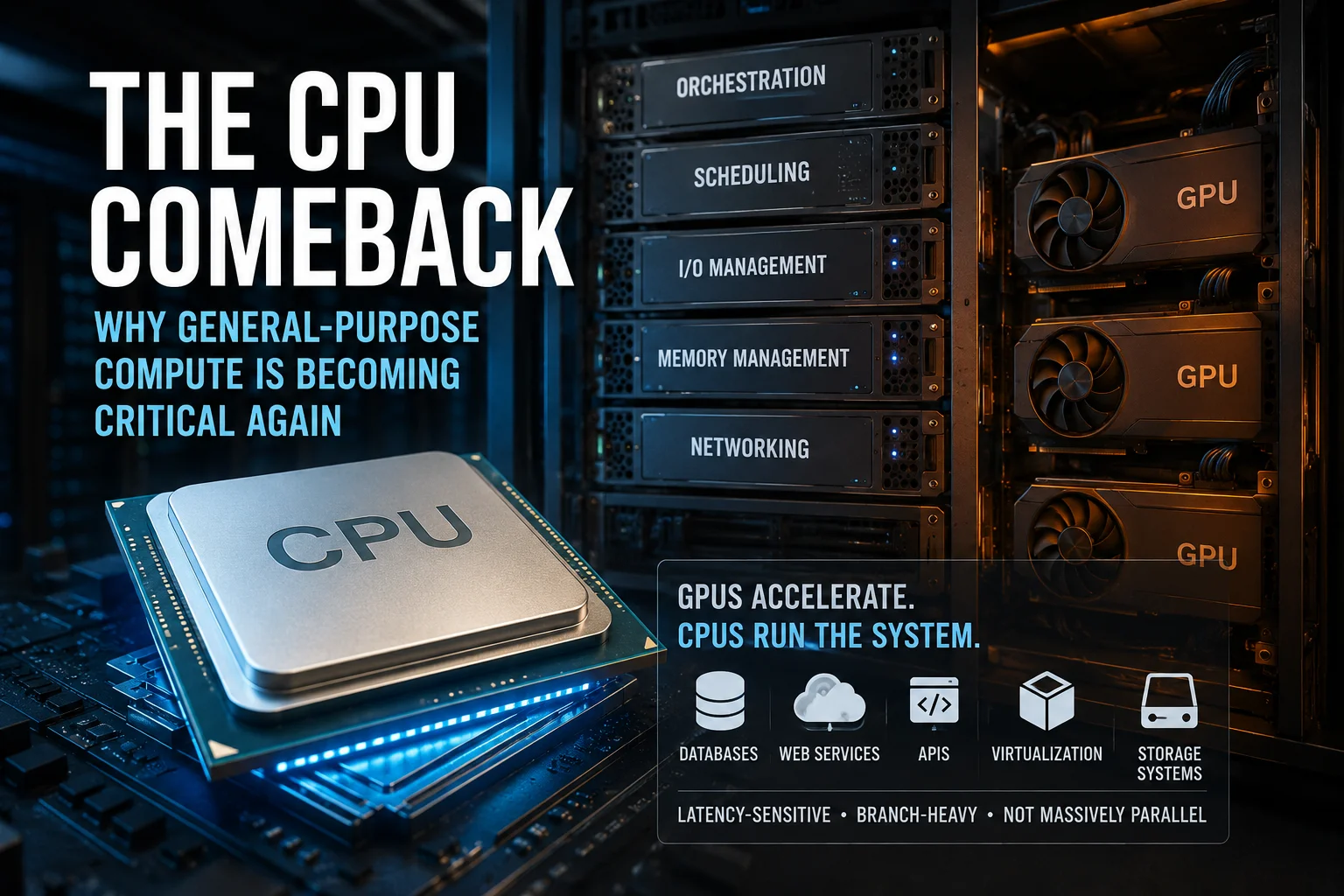
The CPU Comeback: Why General-Purpose Compute Is Becoming Critical Again
Introduction
After years of specialized accelerators dominating data center conversations, general-purpose CPUs are experiencing a quiet renaissance in enterprise infrastructure. While GPUs grabbed headlines for AI workloads and FPGAs promised efficiency gains for specific tasks, CPUs have evolved into more powerful, efficient platforms that handle an expanding range of enterprise compute demands. This shift isn't about replacing accelerators—it's about recognizing where CPU vs GPU computing decisions matter most, and why modern cpu infrastructure provides unique advantages that specialized hardware cannot match.
The resurgence stems from fundamental changes in how enterprises approach compute strategy. Modern applications require flexibility, low latency, and the ability to handle diverse workloads simultaneously. CPUs excel in these areas, offering general purpose compute capabilities that adapt to changing requirements without hardware redesigns. For many organizations, this translates directly into operational efficiency and cost control.
Background
The compute landscape underwent significant specialization over the past decade. Graphics processors moved beyond rendering to tackle parallel workloads in machine learning and scientific computing. Field-programmable gate arrays found niches in high-frequency trading and network processing. Application-specific integrated circuits promised ultimate efficiency for targeted tasks. Each specialized processor offered compelling performance advantages for specific workloads, leading many enterprises to adopt heterogeneous computing architectures.
However, this specialization created new challenges. Managing multiple processor types requires distinct software stacks, different development expertise, and complex orchestration systems. Cloud cpu architecture became fragmented, with workloads distributed across incompatible hardware platforms. Total cost of ownership calculations grew complex when factoring in development time, maintenance overhead, and the risk of architectural dead ends.
Meanwhile, CPU manufacturers invested heavily in architectural improvements. Intel's latest Xeon processors incorporate AI acceleration units directly into general-purpose cores. AMD's EPYC processors deliver exceptional memory bandwidth and core counts that rival many specialized solutions. ARM-based server processors from companies like Graviton offer power efficiency previously associated only with mobile chips.
These improvements arrived alongside software advances that better utilize CPU capabilities. Vectorization techniques extract more parallelism from traditional cores. Just-in-time compilation adapts code optimization to specific CPU features. Container orchestration systems efficiently pack diverse workloads onto the same hardware.
Key Findings
Latency-Critical Applications Drive CPU Adoption
Modern applications increasingly demand predictable, low-latency responses that CPUs deliver more consistently than accelerators. High-frequency trading systems exemplify this requirement, where microsecond delays translate directly into financial losses. These systems rely on cpu latency performance characteristics that remain stable under varying load conditions.
Database systems present another compelling case. While GPUs can accelerate specific query types, most database operations require rapid random memory access, complex branching logic, and immediate response to user requests. PostgreSQL, MongoDB, and other enterprise databases achieve better overall performance on high-core-count CPUs than on hybrid CPU-GPU systems for typical online transaction processing workloads.
Web serving represents the largest latency-sensitive workload category. Companies like Cloudflare and Fastly built their content delivery networks primarily on CPU-based infrastructure because general purpose compute handles the unpredictable mix of request types, security filtering, and edge computing functions that define modern web services.
Cost Economics Favor CPU Consolidation
Total cost analysis reveals surprising advantages for CPU-centric approaches in many scenarios. Netflix's content encoding infrastructure demonstrates this principle. While GPUs can accelerate video encoding, the company found that high-core-count CPUs provided better cost per stream when accounting for software licensing, infrastructure complexity, and operational overhead.
The economics become clearer when examining cpu data center performance across diverse workloads. A single CPU server can simultaneously handle web serving, database queries, batch processing, and monitoring tasks. Specialized accelerators typically excel at one workload type while sitting idle during others, reducing overall utilization and increasing per-unit costs.
Cloud providers validate this analysis through their instance pricing. Amazon's C5 instances, optimized for cpu vs accelerator workloads, often provide better price-performance ratios than GPU instances for applications that don't require massive parallel processing. Google's custom CPU instances allow fine-grained resource allocation that matches workload requirements more precisely than fixed accelerator configurations.
Software Ecosystem Maturity Advantages
The software ecosystem around CPUs offers maturity and breadth that specialized processors struggle to match. Every major programming language, framework, and tool supports CPU execution natively. Legacy applications run without modification. Development teams can apply existing skills and debugging techniques.
Container orchestration systems like Kubernetes excel at managing CPU workloads across heterogeneous clusters. CPU resources scale elastically, allowing precise allocation based on application demands. Memory, networking, and storage resources integrate seamlessly with CPU allocation, simplifying capacity planning and resource optimization.
Open-source projects concentrate primarily on CPU implementations. TensorFlow serves AI inference workloads efficiently on modern CPUs through optimized libraries like Intel MKL-DNN. Apache Spark handles big data processing across CPU clusters with sophisticated optimization techniques. These mature software stacks reduce development risk and accelerate time-to-production.
Power Efficiency Improvements
Modern CPU architectures achieve power efficiency levels that narrow the gap with specialized processors for many workloads. ARM-based server processors like Amazon's Graviton3 deliver exceptional performance per watt for web services, databases, and compute-intensive applications. AMD's latest EPYC processors incorporate advanced power management that dynamically adjusts frequency and voltage based on workload characteristics.
Data center operators notice these improvements directly in cooling and power costs. Microsoft's Azure cloud reports significant efficiency gains from deploying ARM-based virtual machines for appropriate workloads. The combination of lower power consumption and reduced cooling requirements translates into meaningful operational cost reductions.
Flexibility for Evolving Requirements
Enterprise compute strategy increasingly values adaptability over peak specialized performance. Business requirements change faster than hardware refresh cycles, making flexible general purpose compute more valuable than purpose-built accelerators with limited applicability.
The COVID-19 pandemic illustrated this principle dramatically. Organizations needed to rapidly scale video conferencing, remote desktop infrastructure, and collaboration tools. CPU-based systems adapted quickly to these new demands, while specialized AI accelerators sat underutilized as machine learning projects were deprioritized.
Modern cpu infrastructure supports this flexibility through virtualization and containerization technologies that efficiently multiplex diverse workloads. Enterprises can adjust resource allocation based on changing priorities without hardware modifications or lengthy procurement cycles.
Implications
The CPU resurgence affects enterprise technology decisions across multiple dimensions. Infrastructure teams must reconsider architecture assumptions that favored specialized accelerators for specific workloads. The total cost equation now includes factors like operational complexity, software ecosystem maturity, and adaptation flexibility that often favor CPU solutions.
Cloud strategy decisions require updated analysis of cpu vs gpu computing tradeoffs. While GPUs remain optimal for training large neural networks and highly parallel scientific computing, many AI inference workloads, data analytics tasks, and hybrid applications achieve better economics on modern CPU platforms.
Procurement processes need adjustment to reflect these changing dynamics. Rather than defaulting to the latest accelerator technology, organizations should evaluate whether enhanced CPU capabilities meet requirements at lower total cost and complexity. This evaluation must include software development costs, operational overhead, and long-term flexibility requirements.
Development teams benefit from focusing expertise on CPU optimization techniques rather than spreading knowledge across multiple specialized platforms. Modern CPUs offer sophisticated features like vector processing, memory prefetching, and dynamic frequency scaling that require specific optimization approaches to achieve maximum performance.
Data center design implications extend beyond individual server selection. CPU-centric architectures simplify cooling, power distribution, and rack design compared to heterogeneous accelerator deployments. Network architecture can optimize for the different traffic patterns and latency requirements that CPU workloads typically exhibit.
Considerations
The CPU comeback doesn't eliminate use cases where specialized accelerators provide clear advantages. Large-scale neural network training still benefits from GPU parallelism. Specific signal processing applications may require FPGA flexibility. Cryptocurrency mining demands ASIC efficiency. Organizations must evaluate workload characteristics carefully rather than assuming CPU solutions always provide better value.
Software optimization becomes more critical when relying on general purpose compute. CPUs achieve their best performance only when applications utilize modern instruction sets, vectorization techniques, and efficient memory access patterns. Legacy software may not benefit from enhanced CPU capabilities without modification.
Vendor lock-in risks shift rather than disappear with CPU-focused strategies. While the CPU ecosystem offers more choice than specialized accelerator markets, architectural differences between Intel, AMD, and ARM platforms create compatibility considerations that affect long-term flexibility.
Performance predictability varies across workload types. While CPUs excel at consistent latency for interactive applications, they may exhibit variable performance for batch processing tasks under heavy multitenant scenarios. Understanding these performance characteristics helps set appropriate expectations and service level agreements.
Market dynamics continue evolving rapidly. Specialized accelerator vendors actively address cost, complexity, and software ecosystem limitations. Future generations of GPUs, FPGAs, and custom chips may resolve current disadvantages while maintaining their specialized performance advantages.
Key Takeaways
• Latency-sensitive applications favor CPU architectures due to predictable performance characteristics and lower response time variability compared to accelerator-based solutions.
• Total cost analysis often favors CPU consolidation when accounting for software complexity, operational overhead, and resource utilization across diverse workload mixes.
• Software ecosystem maturity provides significant advantages for CPU-based solutions, including broader tool support, extensive optimization libraries, and reduced development risk.
• Modern CPU power efficiency narrows the energy consumption gap with specialized processors while maintaining flexibility for changing workload requirements.
• Infrastructure simplification benefits emerge from standardizing on general purpose compute, reducing cooling complexity, operational training requirements, and procurement overhead.
• Workload evaluation remains critical as specialized accelerators still provide compelling advantages for specific use cases like large-scale AI training and highly parallel scientific computing.
• Strategic flexibility becomes increasingly valuable as business requirements evolve faster than hardware refresh cycles, making adaptable CPU infrastructure more attractive than purpose-built accelerator solutions.