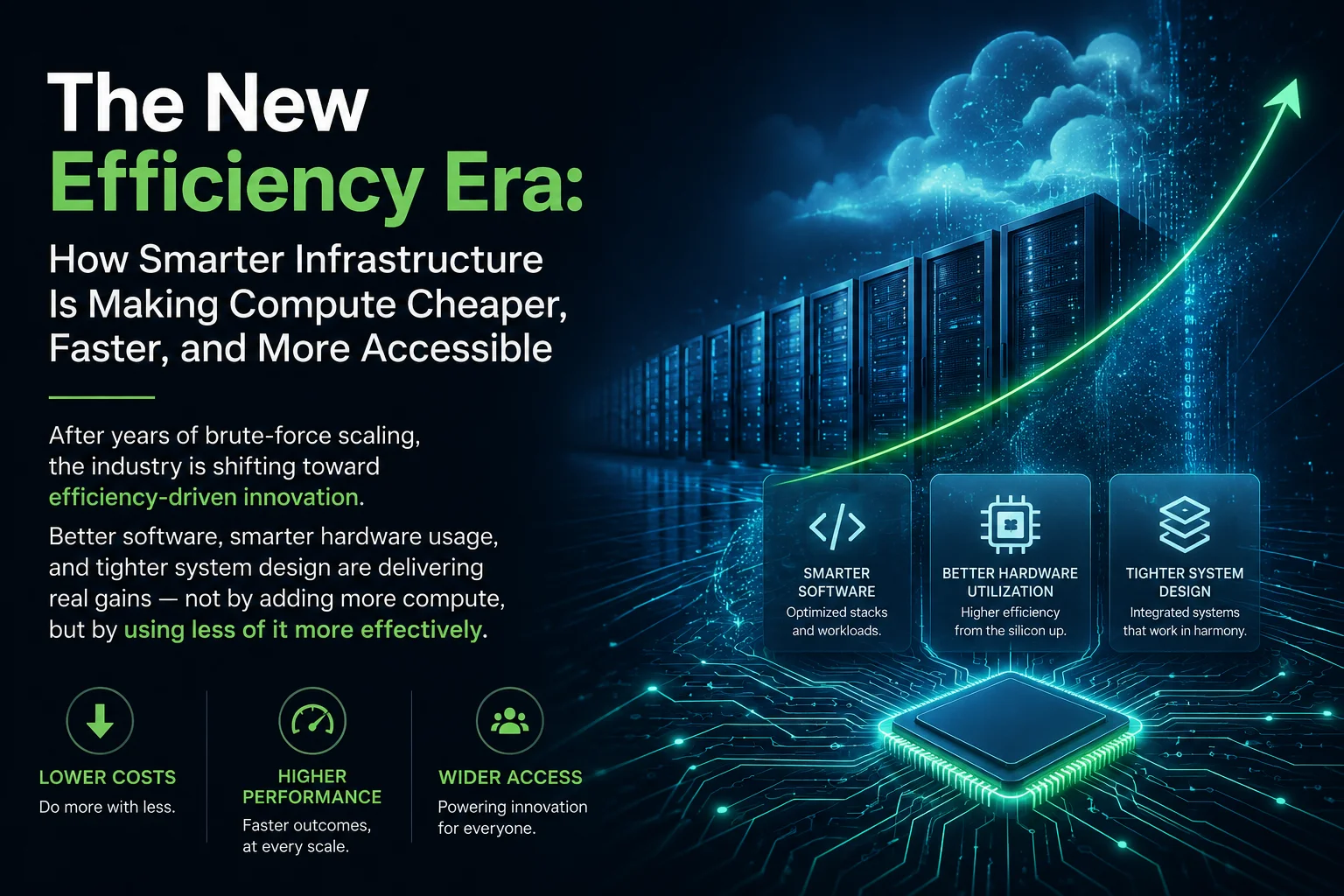
The New Efficiency Era: How Smarter Infrastructure Is Making Compute Cheaper, Faster, and More Accessible
Introduction
Enterprise computing costs have reached an inflection point. Companies running large-scale AI workloads report infrastructure expenses consuming 30-60% of their operational budgets, while traditional compute-intensive industries face similar pressures from rising energy costs and hardware constraints. This economic reality is driving a fundamental shift toward AI infrastructure efficiency and compute optimization, where getting more performance per dollar has become as critical as raw computational power.
The efficiency movement spans multiple layers of the computing stack, from hardware acceleration and model quantization techniques to energy efficient data centers and intelligent resource allocation. Unlike previous optimization waves that focused primarily on speed, this trend addresses the full economic equation: performance, power consumption, hardware utilization, and operational overhead. The result is a new class of infrastructure optimization strategies that make high-performance computing accessible to a broader range of organizations while reducing the environmental and financial costs of large-scale computation.
Current State
Modern AI infrastructure operates under significant economic and technical constraints. Training a large language model can cost millions of dollars in compute resources, while inference serving for production applications generates ongoing operational expenses that scale with user demand. Companies like Anthropic and OpenAI report infrastructure costs representing their largest operational expense category, driving intense focus on AI cost reduction strategies.
The current infrastructure landscape reflects these pressures through several observable patterns. Cloud providers have expanded their offerings of specialized AI accelerators, with AWS offering multiple instance types optimized for different workload characteristics, Google Cloud providing TPU pods for large-scale training, and Microsoft Azure delivering GPU clusters designed for both training and inference workloads. These platforms now provide detailed cost optimization tools that help organizations understand their compute spending patterns and identify efficiency opportunities.
On the hardware side, organizations are deploying increasingly sophisticated cooling and power management systems in their data centers. Facilities designed for AI workloads typically consume 30-50% more power per rack than traditional enterprise computing environments, making energy efficient data centers a operational necessity rather than an environmental preference. Companies report power and cooling costs representing 25-40% of their total infrastructure expenses for GPU-heavy workloads.
Software optimization has become equally critical. Model quantization techniques that reduce the precision of neural network weights from 32-bit floating point to 16-bit or even 8-bit integers can cut memory requirements by half or more while maintaining acceptable accuracy levels. Framework optimizations in TensorFlow, PyTorch, and specialized inference engines like NVIDIA's TensorRT demonstrate measurable performance improvements through better hardware utilization and reduced memory overhead.
Emerging Patterns
Several distinct efficiency patterns are reshaping how organizations approach AI infrastructure. The most significant involves the decoupling of training and inference optimization strategies. While training workloads benefit from raw computational power and high-bandwidth memory systems, inference workloads prioritize low latency, high throughput, and consistent performance per watt. This recognition has led to specialized deployment architectures where different hardware and software configurations handle these distinct phases.
Efficient computing systems increasingly rely on heterogeneous architectures that match specific hardware capabilities to workload requirements. Organizations deploy combinations of CPUs for control logic and data preprocessing, GPUs for parallel computation, and specialized accelerators like Google's TPUs or AWS Inferentia chips for specific AI tasks. This approach contrasts with previous homogeneous deployments where the same hardware handled all workload types, often inefficiently.
Model optimization techniques are becoming more sophisticated and automated. Techniques like neural architecture search automatically identify efficient model structures, while pruning algorithms remove unnecessary model parameters without significant accuracy loss. Companies report achieving 10x reductions in model size and inference latency through systematic optimization approaches, making previously resource-intensive models viable for edge deployment and real-time applications.
Infrastructure automation is evolving beyond basic resource provisioning to include intelligent workload placement and dynamic optimization. Modern orchestration systems can automatically move workloads between different hardware types based on current demand, cost considerations, and performance requirements. This dynamic approach enables organizations to maintain performance standards while minimizing costs through intelligent resource utilization.
Driving Factors
The efficiency trend stems from converging economic, technical, and operational forces. Rising energy costs, particularly in regions with limited renewable energy availability, directly impact the total cost of ownership for compute-intensive workloads. Organizations operating large-scale AI infrastructure report electricity costs increasing 15-25% annually, making energy efficiency a direct factor in profitability calculations.
Hardware availability constraints force efficiency improvements through necessity. GPU shortages and long procurement cycles mean organizations must extract maximum value from existing hardware investments. This scarcity drives adoption of model quantization, efficient scheduling algorithms, and multi-tenancy approaches that allow multiple workloads to share expensive accelerator hardware.
Competitive pressures in AI applications create demand for both higher performance and lower costs. Companies deploying AI features in consumer applications need to serve millions of users cost-effectively, while enterprise AI solutions must demonstrate clear return on investment calculations. This dual requirement pushes organizations toward infrastructure architectures that can scale efficiently without proportional increases in operational costs.
Technical advances in compiler technology and hardware-software co-design enable new optimization possibilities. Modern AI compilers can automatically optimize neural network execution for specific hardware targets, while emerging hardware includes specialized instructions and memory hierarchies designed for common AI operations. These improvements allow organizations to achieve better performance from existing hardware investments through software updates rather than hardware replacements.
Regulatory and environmental considerations increasingly influence infrastructure decisions. European data protection regulations create requirements for local data processing, driving demand for efficient edge computing systems. Corporate sustainability commitments require measurable reductions in energy consumption, making data center efficiency a business necessity rather than an optional improvement.
Enterprise Implications
Organizations face strategic decisions about infrastructure investment priorities and architectural approaches. The traditional model of over-provisioning hardware to handle peak workloads becomes economically unsustainable at scale, requiring more sophisticated capacity planning and dynamic resource management. Companies must develop capabilities in workload analysis, performance modeling, and cost optimization to operate efficiently in this environment.
Infrastructure procurement strategies are shifting toward performance-per-dollar metrics rather than absolute performance specifications. This change requires deeper technical evaluation of hardware options, including understanding the performance characteristics of different accelerator types, memory configurations, and networking architectures for specific workload patterns. Organizations need expertise in benchmarking and performance analysis to make informed purchasing decisions.
The skills and organizational structure required for efficient AI infrastructure differ significantly from traditional IT operations. Teams need expertise in model optimization, hardware-software co-design, and sophisticated monitoring and analysis tools. Many organizations are establishing dedicated platform engineering teams focused specifically on infrastructure efficiency and cost optimization.
Vendor relationships and procurement processes must accommodate the rapid pace of hardware and software innovation in this space. Traditional multi-year procurement cycles become problematic when new hardware generations offer 2-3x performance improvements or when software optimizations can deliver similar benefits through updates. Organizations need more flexible procurement approaches and vendor relationships that support continuous optimization efforts.
Risk management considerations include the tradeoffs between efficiency optimization and system reliability. Aggressive optimization techniques can introduce failure modes or performance edge cases that impact production systems. Organizations must balance cost reduction goals with operational stability requirements, often requiring sophisticated testing and gradual rollout processes for efficiency improvements.
Considerations
The efficiency movement faces several practical constraints and potential downsides that organizations must navigate carefully. Optimization complexity increases significantly as systems become more sophisticated, requiring specialized expertise that may not be available in all organizations. The learning curve for advanced techniques like model quantization, hardware-specific optimizations, and dynamic resource management can be steep and expensive.
Vendor lock-in risks increase with highly optimized systems that depend on specific hardware or software platforms. Organizations may find themselves unable to migrate workloads between different cloud providers or hardware platforms without significant re-engineering efforts. This constraint can limit negotiating power and increase long-term costs despite short-term efficiency gains.
The rapid pace of innovation in this space creates timing challenges for infrastructure investments. Hardware and software capabilities improve quickly enough that decisions made today may become suboptimal within 12-18 months. Organizations must balance the benefits of immediate optimization against the risk of investing in approaches that become obsolete relatively quickly.
Performance optimization often involves tradeoffs with other system characteristics like maintainability, debuggability, and flexibility. Highly optimized systems can be more difficult to modify or troubleshoot when problems occur. Organizations need to consider their long-term operational capabilities and requirements when implementing aggressive efficiency measures.
Market dynamics around AI infrastructure remain volatile, with significant price fluctuations in cloud services, hardware availability, and energy costs. Optimization strategies that provide benefits under current conditions may become less effective if underlying cost structures change significantly. Organizations need contingency planning and flexibility in their infrastructure approaches.
Key Takeaways
• Infrastructure efficiency has become a competitive advantage: Organizations that master compute optimization can operate AI workloads at significantly lower costs, enabling broader deployment and faster iteration cycles than competitors relying on brute-force approaches.
• Specialization trumps generalization: The most efficient systems use different hardware and software configurations optimized for specific workload types rather than homogeneous infrastructures, requiring sophisticated workload analysis and resource management capabilities.
• Optimization requires systematic approaches: Ad-hoc efficiency improvements deliver limited benefits compared to comprehensive strategies that address hardware selection, software optimization, and operational processes together as an integrated system.
• Skills and organizational capabilities are critical: Successful infrastructure efficiency requires specialized technical expertise in areas like model optimization, performance analysis, and hardware-software co-design that many organizations currently lack.
• Economic pressures will intensify: Rising energy costs, hardware constraints, and competitive requirements will continue driving demand for more efficient computing approaches, making this a persistent rather than temporary trend.
• Flexibility must be preserved: The most effective efficiency strategies maintain the ability to adapt to changing requirements and technologies rather than over-optimizing for current conditions at the expense of future adaptability.
• Risk management becomes more complex: Highly optimized systems can introduce new failure modes and operational complexities that require sophisticated monitoring, testing, and incident response capabilities.