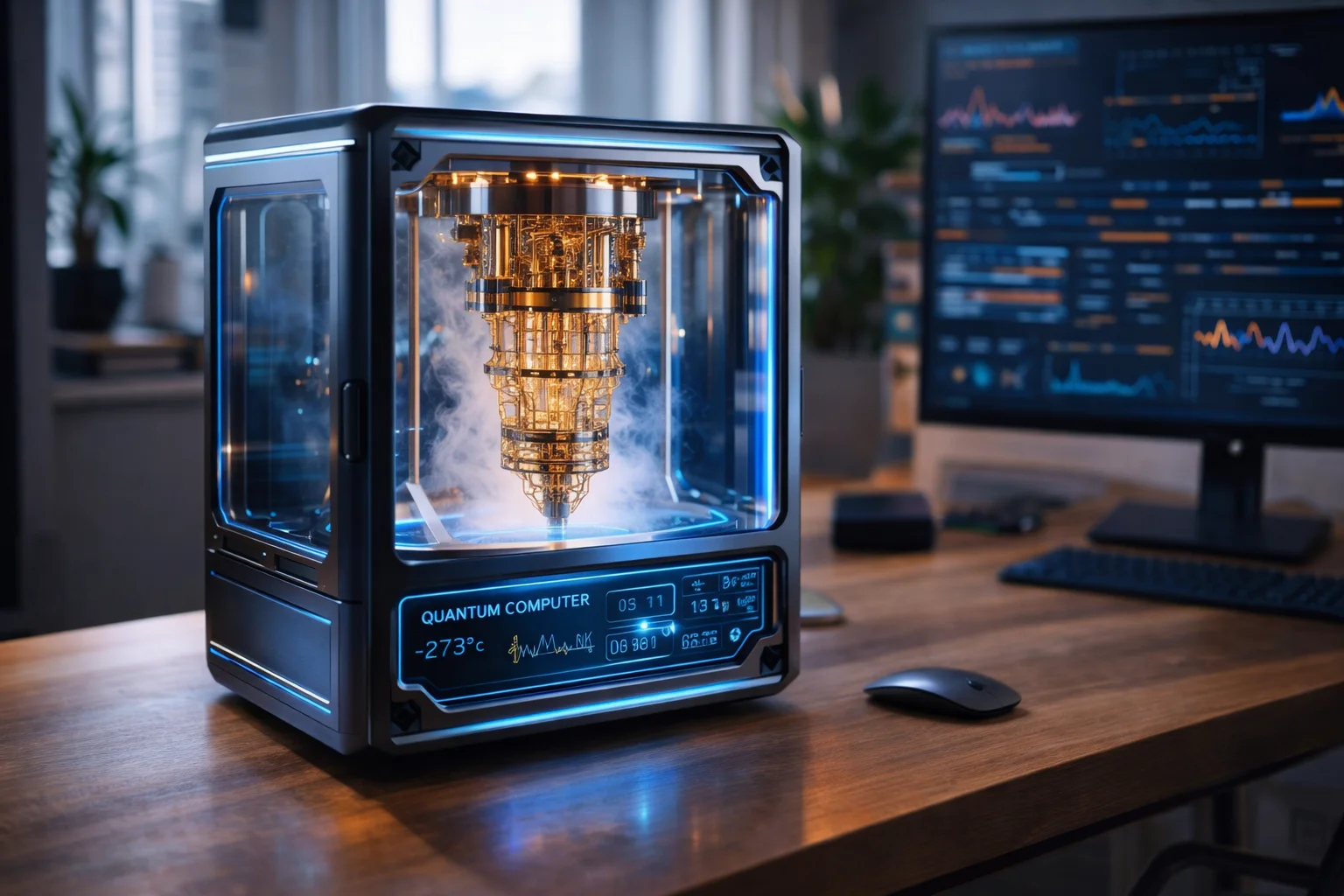
Why Home Quantum Computers Are Not Coming Anytime Soon
Introduction
The quantum computing industry has generated significant enterprise investment and research momentum, with companies like IBM, Google, and Rigetti making substantial advances in quantum processing capabilities. However, misconceptions persist about quantum computing's trajectory toward consumer adoption. Enterprise decision-makers evaluating quantum strategies often encounter marketing materials suggesting imminent consumer quantum devices, creating unrealistic expectations about deployment timelines and practical applications.
Understanding the fundamental barriers to home quantum computers is crucial for CTOs and technical leaders making strategic technology investments. The constraints that keep quantum systems confined to specialized research facilities and enterprise data centers are not temporary engineering challenges but fundamental physics and engineering requirements that define how quantum computers must operate. These limitations have profound implications for quantum computing's role in enterprise architecture and technology roadmaps.
The gap between current quantum hardware requirements and consumer electronics represents one of the most significant technological chasms in modern computing. While classical computers evolved from room-sized machines to pocket devices through incremental improvements in manufacturing and design, quantum computers face physics-based constraints that prevent similar miniaturization and cost reduction.
What Is Consumer Quantum Computing?
Consumer quantum computing would theoretically involve quantum processing devices designed for home use, personal applications, and individual ownership. This concept envisions quantum computers that operate like traditional personal computers: purchased by individuals, installed in homes or offices, and used for everyday computing tasks that benefit from quantum algorithms.
Current quantum computing development focuses exclusively on enterprise and research applications. Companies like IBM offer cloud-based quantum computing access through their Quantum Network, allowing enterprises to run quantum algorithms on actual quantum hardware located in IBM's specialized facilities. Google's quantum supremacy experiments occur in highly controlled laboratory environments, while commercial quantum computing companies like IonQ and Rigetti target enterprise customers with specific computational problems.
The fundamental distinction between current quantum systems and hypothetical consumer devices lies in operational requirements. Enterprise quantum computers operate in dedicated facilities with specialized infrastructure, technical support, and specific computational workflows. Consumer quantum computing would require quantum systems that function reliably in uncontrolled environments, serve general-purpose applications, and operate without technical expertise.
No major technology company has announced consumer quantum computing products or research programs. The quantum computing roadmaps from IBM, Google, Amazon, and Microsoft focus entirely on enterprise applications, cloud services, and research partnerships. This strategic focus reflects the technical realities of quantum hardware rather than market timing decisions.
How It Works
Quantum computers operate through quantum mechanical effects that require extreme environmental control and precision engineering. Understanding these operational requirements reveals why consumer quantum devices remain technically infeasible.
Quantum computers store and process information using quantum bits (qubits) that exist in quantum superposition states. Unlike classical bits that represent either 0 or 1, qubits can represent both states simultaneously until measurement collapses them into definite values. This quantum superposition enables quantum computers to perform certain calculations exponentially faster than classical computers.
However, qubits are extraordinarily fragile. Quantum decoherence occurs when qubits interact with their environment, causing quantum information to degrade rapidly. Current quantum computers combat decoherence through multiple approaches: extreme cooling systems, electromagnetic shielding, vibration isolation, and error correction protocols.
Most quantum computers require cryogenic cooling to near absolute zero temperatures, typically around 0.01 Kelvin (-273.14°C). This cooling is achieved using dilution refrigerators that cost hundreds of thousands of dollars and consume significant electrical power. Google's Sycamore quantum processor operates in a dilution refrigerator the size of a large closet, requiring specialized helium-3 isotopes for cooling.
Superconducting quantum computers, used by IBM and Google, require superconducting circuits that only function at extremely low temperatures. The superconducting state eliminates electrical resistance, allowing quantum coherence to persist longer. Warming these systems above critical temperatures immediately destroys their quantum properties.
Ion trap quantum computers, developed by companies like IonQ and Honeywell, use electromagnetic fields to trap individual ions in vacuum chambers. These systems require ultra-high vacuum conditions and precise laser control systems for qubit manipulation. The vacuum pumping systems and laser infrastructure occupy substantial space and require constant maintenance.
Photonic quantum computers attempt to use photons as qubits, potentially operating at higher temperatures. However, photonic systems require complex optical setups with precise alignment, specialized detectors, and sophisticated error correction. Companies like Xanadu have demonstrated photonic quantum computers, but these systems still require controlled laboratory environments.
Error correction in quantum computers requires hundreds or thousands of physical qubits to create single logical qubits with sufficient stability for computation. Current quantum computers operate with dozens to hundreds of qubits, all of which are physical qubits without full error correction. Fault-tolerant quantum computers that could run extended algorithms will likely require millions of physical qubits.
Enterprise Applications
Quantum computing's enterprise applications focus on specific computational problems where quantum algorithms provide theoretical advantages over classical approaches. These applications justify the substantial infrastructure investments required for quantum systems.
Financial services companies explore quantum computing for portfolio optimization, risk analysis, and derivative pricing. JPMorgan Chase collaborates with IBM to investigate quantum algorithms for options pricing and risk management. The quantum advantage in these applications comes from quantum computers' ability to explore multiple solution paths simultaneously, potentially finding optimal solutions faster than classical algorithms.
Pharmaceutical and chemical companies investigate quantum computing for molecular simulation and drug discovery. Quantum computers could theoretically simulate molecular behavior more accurately than classical computers because molecules themselves operate according to quantum mechanics. Companies like Roche and Merck partner with quantum computing firms to explore quantum algorithms for drug discovery workflows.
Logistics and supply chain optimization represent another quantum computing application area. Companies like Volkswagen have experimented with quantum algorithms for traffic flow optimization and route planning. The quantum advantage emerges from quantum computers' ability to simultaneously evaluate multiple optimization paths in complex, multi-variable problems.
Cybersecurity applications include both opportunities and threats. Quantum computers could potentially break current encryption algorithms, motivating enterprises to develop quantum-resistant cryptography. Simultaneously, quantum cryptography could provide theoretically unbreakable communication security through quantum key distribution.
Machine learning and artificial intelligence research explores quantum algorithms for pattern recognition, optimization, and data analysis. Quantum machine learning algorithms could potentially provide speedups for certain types of data processing, particularly in high-dimensional optimization problems.
These enterprise applications share common characteristics: they involve complex optimization problems, benefit from quantum algorithms' theoretical advantages, and justify substantial investment in quantum computing infrastructure. None of these applications require personal ownership of quantum computers or home-based quantum processing.
Tradeoffs and Considerations
The path from current quantum computers to hypothetical consumer devices faces fundamental physics and engineering constraints that may be insurmountable with known technologies.
Cryogenic cooling requirements represent the most obvious barrier to consumer quantum computing. Dilution refrigerators consume substantial electrical power, require specialized maintenance, and cost more than most homes. The cooling systems must run continuously to maintain quantum states, creating ongoing operational costs that would dwarf typical household electronics expenses.
Even if room-temperature quantum computers were developed, they would face severe limitations in quantum coherence times. Higher temperatures increase environmental noise and accelerate quantum decoherence. Current research into room-temperature quantum systems has achieved only limited coherence times, insufficient for complex quantum algorithms.
Error correction overhead makes consumer quantum computers economically impractical. Fault-tolerant quantum computers require thousands of physical qubits to create single logical qubits with sufficient stability. The computational overhead of error correction means that useful quantum computers need millions of physical qubits. Manufacturing and controlling millions of qubits would require industrial-scale systems.
Quantum computers excel at specific algorithmic problems but offer no advantage for typical consumer computing tasks. Web browsing, document editing, media playback, and most software applications gain no benefit from quantum processing. Classical computers will remain more efficient for these applications regardless of quantum computing advances.
Control systems for quantum computers require sophisticated classical computing infrastructure. Quantum computers need classical computers to control qubits, process measurement results, and implement error correction protocols. The classical control systems often represent the majority of a quantum computer's physical footprint and power consumption.
Quantum programming requires specialized expertise in quantum mechanics, linear algebra, and quantum algorithms. Consumer software developers lack the quantum computing knowledge needed to create consumer quantum applications. Educational infrastructure for quantum programming remains limited even in enterprise and academic contexts.
Quantum computers cannot store quantum states persistently. Unlike classical computers that store data in stable magnetic or electronic states, quantum information degrades rapidly and cannot be "saved" in traditional ways. This limitation requires quantum computations to complete within coherence times, typically microseconds to milliseconds.
Implementation Landscape
The current quantum computing ecosystem demonstrates why consumer adoption remains distant and why enterprise adoption follows specific patterns driven by computational requirements rather than general computing needs.
Cloud-based quantum computing represents the dominant model for enterprise quantum access. Amazon Web Services offers Braket, a quantum computing service that provides access to quantum hardware from IonQ, Rigetti, and D-Wave. Microsoft Azure Quantum provides similar cloud access to quantum systems. Google Cloud offers access to quantum processors through partnerships with quantum computing companies.
This cloud model eliminates the infrastructure barriers for enterprise quantum experimentation. Companies can run quantum algorithms without owning quantum hardware, paying only for computational time used. The cloud approach also provides access to different quantum computing technologies, allowing enterprises to experiment with superconducting, ion trap, and photonic quantum systems.
Specialized quantum computing facilities represent another implementation model. National laboratories like Oak Ridge and Argonne operate quantum computing centers that provide access to research institutions and enterprises. These facilities concentrate quantum expertise, infrastructure, and maintenance capabilities in dedicated environments.
Quantum computing partnerships between technology companies and quantum hardware manufacturers define most enterprise quantum initiatives. IBM's Quantum Network includes over 140 companies, universities, and research institutions that collaborate on quantum computing research. These partnerships provide enterprises with quantum expertise while quantum companies gain access to real-world computational problems.
Educational initiatives attempt to build quantum computing expertise within enterprises. Universities offer quantum computing programs and certifications, while companies like IBM provide quantum computing training through their Qiskit platform. However, the specialized knowledge required for quantum programming remains a significant barrier to broader adoption.
The timeline for quantum computing deployment focuses on specific enterprise applications rather than general computing replacement. Industry analysts predict quantum advantage for certain optimization and simulation problems within the next decade, but these applications will remain in specialized enterprise contexts.
Quantum computing infrastructure continues to require dedicated facilities, specialized personnel, and substantial capital investment. These requirements reinforce the enterprise-focused development model and make consumer quantum computing economically impractical.
Key Takeaways
• Fundamental physics constraints prevent miniaturization: Quantum computers require extreme cooling, precise control systems, and error correction overhead that cannot be reduced to consumer electronics form factors with known technologies.
• Cryogenic cooling systems cost more than homes: Dilution refrigerators that maintain quantum states cost hundreds of thousands of dollars, consume substantial power, and require specialized maintenance that makes home ownership economically impossible.
• Error correction requires millions of qubits: Fault-tolerant quantum computers need massive qubit arrays to create stable logical qubits, requiring industrial-scale manufacturing and control systems incompatible with consumer devices.
• Quantum computers offer no advantage for consumer applications: Web browsing, productivity software, media consumption, and typical personal computing tasks gain no benefit from quantum processing and remain more efficient on classical computers.
• Cloud-based access eliminates ownership needs: Enterprise quantum computing adoption occurs through cloud services and specialized facilities, providing quantum capabilities without infrastructure ownership or consumer device development.
• Specialized expertise requirements persist: Quantum programming requires deep knowledge of quantum mechanics and specialized algorithms that remain far beyond typical consumer software development capabilities.
• Enterprise applications drive quantum investment: Financial optimization, molecular simulation, and cryptography applications justify quantum computing infrastructure costs for specific enterprise problems, but these use cases do not translate to consumer market opportunities.