Summary
AWS has made EC2 P6-B300 instances generally available, giving customers access to an eight-GPU Blackwell Ultra platform with 2.1 TB of aggregate HBM3e memory and 6.4 Tbps of Elastic Fabric Adapter networking. The headline number is important, but the more useful infrastructure lesson is that cloud AI platforms are being judged less by raw GPU count and more by the balance between accelerator memory, GPU-to-GPU interconnect, east-west cluster bandwidth, storage ingress, reservation mechanics, and security isolation.
For engineering leaders, P6-B300 should be evaluated as a cluster building block rather than as a faster replacement for an older instance family. Its practical value depends on whether a workload is constrained by model sharding, KV-cache capacity, all-reduce overhead, data loading, or procurement flexibility. That makes the instance notable even for teams that will not immediately deploy it: it shows where the next round of enterprise AI infrastructure decisions is moving.
What AWS Actually Announced
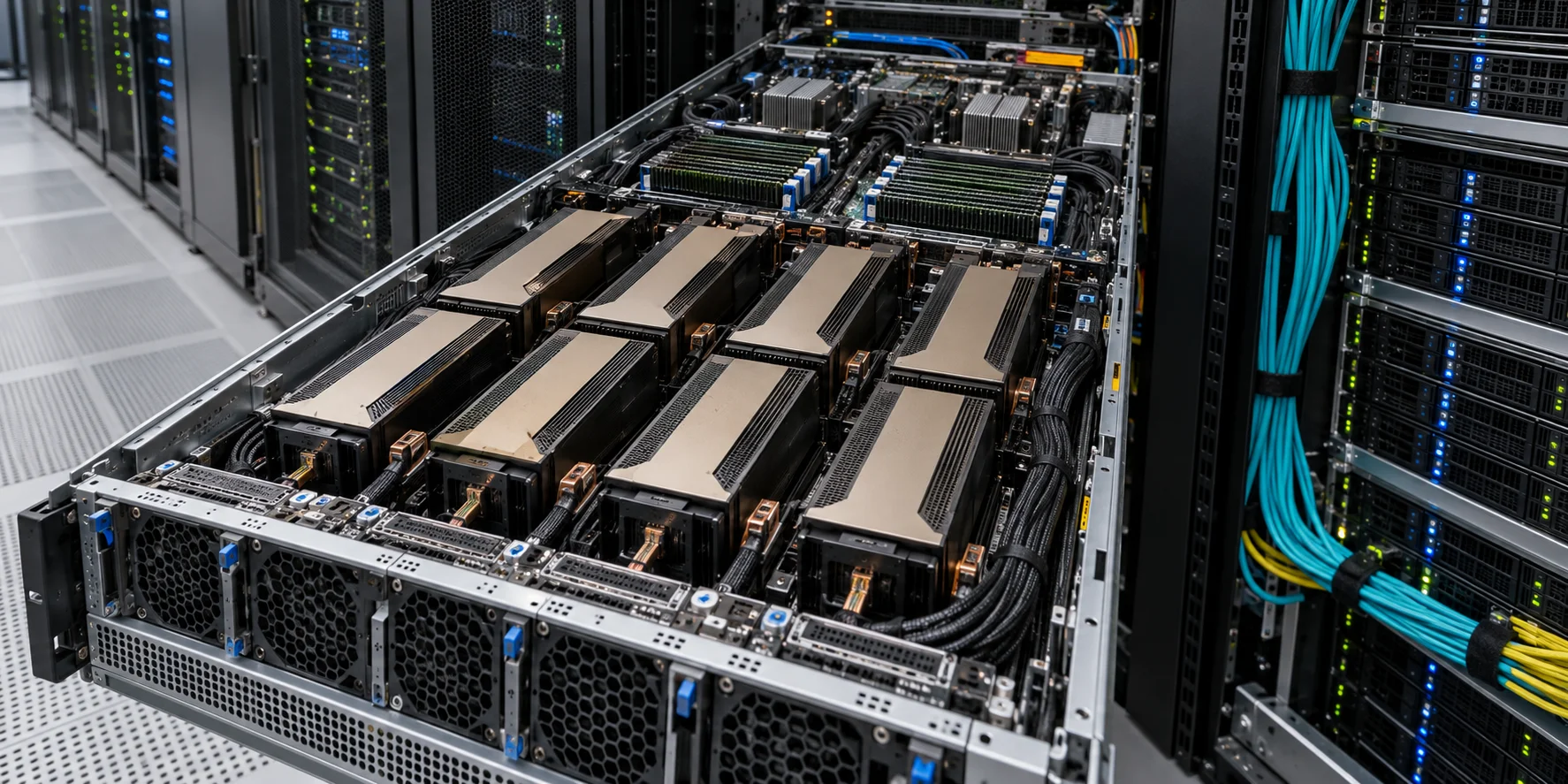
AWS describes P6-B300 as a next-generation EC2 GPU platform accelerated by NVIDIA Blackwell Ultra GPUs. The single published size, P6-B300.48xlarge, includes 192 vCPUs, 4 TB of system memory, eight NVIDIA B300 GPUs, 2,144 GB of HBM3e GPU memory, 1,800 GB/s GPU-to-GPU interconnect, 6.4 Tbps EFA bandwidth, 300 Gbps ENA bandwidth, 100 Gbps EBS bandwidth, and eight 3.84 TB local NVMe devices.
The instance is initially available in the US West (Oregon) Region through EC2 Capacity Blocks for ML and Savings Plans. AWS also points customers toward account-manager engagement for on-demand reservation. That matters because large GPU systems are no longer just a technical resource; they are a capacity-planning instrument. A team that needs thousands of accelerators for a model run or a major inference migration must now reason about reservation windows, data staging, regional placement, failover strategy, and the cost of idle time with the same rigor it applies to model architecture.
AWS positions the platform for large-scale training and serving, including Mixture-of-Experts and multimodal workloads. Those are reasonable targets because the major constraints in these systems often appear outside the tensor core. MoE routing, long-context inference, retrieval augmentation, and multimodal preprocessing can all magnify memory pressure and communication overhead. P6-B300’s enterprise relevance is that it increases several parts of the envelope at once rather than improving only accelerator arithmetic.
Why the Memory Increase Changes Model Placement
The 2,144 GB of aggregate HBM3e across eight GPUs is the most obvious differentiator. Compared with smaller accelerator envelopes, more HBM can reduce the need to shard model weights, expert parameters, activation state, or KV cache across larger groups of nodes. That has direct operational consequences: fewer cross-node dependencies, fewer synchronization points, simpler placement rules, and potentially lower sensitivity to network jitter.
The benefit is not automatic. Larger HBM capacity only helps if the serving or training stack can use it efficiently. Framework choices, tensor parallelism settings, expert parallelism strategies, quantization formats, and cache eviction policies still determine whether the memory becomes useful throughput or expensive headroom. For inference-heavy deployments, the sizing question is often not simply “can the model fit?” but “how many concurrent sequences can fit while meeting latency targets and preserving enough reserve for bursts?”
This is where enterprise buyers should avoid the trap of comparing instances only by GPU generation. A medium-sized model that fits comfortably on a cheaper instance may not benefit from P6-B300 unless the workload also needs higher batch concurrency, longer context windows, multi-model consolidation, or reduced operational complexity. Conversely, a frontier-scale or MoE workload may justify the platform because keeping more of the working set inside a high-bandwidth domain can remove expensive distributed-systems workarounds.
Networking Is Becoming a First-Class Accelerator Feature
AWS’s 6.4 Tbps EFA figure is not a footnote. Distributed AI performance depends heavily on how fast the cluster can exchange gradients, activations, KV-cache state, and pipeline-parallel traffic. As model sizes and context lengths increase, the gap between theoretical GPU throughput and realized application throughput is often explained by communication patterns.
The P6-B300 announcement follows a broader AWS/NVIDIA collaboration that includes Spectrum networking work and NVIDIA Inference Xfer Library support over EFA. That direction is important: inference infrastructure is becoming disaggregated, with prefill, decode, cache movement, and serving orchestration handled by specialized components. In that architecture, the network is part of the inference engine. A poor fabric can erase the advantage of the newest GPU.
Enterprises should therefore benchmark with real communication behavior, not just synthetic kernel tests. Training runs need representative all-reduce, checkpoint, and data-loader patterns. Inference tests need realistic prompt lengths, output lengths, cache reuse, admission control, and failure handling. Network-sensitive workloads should also test multi-node scaling efficiency because a single-node result can hide the bottleneck that will dominate production.
Storage Throughput Still Determines Time to First Token and Time to Train
AWS calls out several storage paths: FSx for Lustre, S3 Express One Zone, and EBS. It also notes that P6-B300 can use EFA with NVIDIA GPUDirect Storage to reach up to 1.2 Tbps of throughput to an FSx for Lustre file system. That is a practical acknowledgement that large GPU fleets waste money when data cannot arrive fast enough.
For training, storage limits show up during dataset reads, checkpoint writes, restart events, and preprocessing bursts. For inference, they appear during model loading, adapter swaps, retrieval indexing, and warm-up after scale-out. The local NVMe devices on P6-B300 are useful, but they do not remove the need for a deliberate data path. Teams should decide which artifacts belong in object storage, which require parallel file-system semantics, and which should be staged locally before a reservation window begins.
The operational metric to watch is not peak storage throughput in isolation. It is accelerator utilization over the full job lifecycle. If a Capacity Block is consumed while the cluster waits for checkpoints, model weights, or dataset shards, the apparent hourly price of the GPU is misleading. Data readiness becomes part of capacity economics.
Capacity Blocks Make Architecture and Procurement Interdependent
The availability model is almost as important as the hardware. Capacity Blocks for ML suit planned, time-bound jobs, but they reward teams that can make workloads predictable. That changes engineering incentives. Training pipelines need reliable restart behavior, observability, automated validation, and known scaling profiles. Inference migrations need traffic replay, rollback plans, and load-generation evidence before scarce capacity is reserved.
This pushes AI infrastructure closer to HPC operations than traditional elastic web operations. Cluster windows, job queues, storage staging, and utilization accounting become normal enterprise concerns. The cloud still reduces the need to own the physical plant, but it does not eliminate scheduling discipline. If anything, high-end accelerator scarcity makes discipline more valuable.
CFOs and CTOs should also view P6-B300 in the context of AWS and NVIDIA’s broader plan to deploy millions of additional GPUs across AWS global infrastructure in 2027 and 2028. The signal is that supply is expanding, but not in a way that makes planning irrelevant. Large customers will still compete for region, generation, reservation length, and adjacent services. The organizations that can express demand precisely will have an advantage over those that treat GPU access as an undifferentiated cloud commodity.
Security and Isolation Are Part of the Platform Decision
AWS emphasizes the Nitro System and EFA as part of the P6-B300 environment, while NVIDIA’s Blackwell materials emphasize confidential computing, NVLink protections, RAS features, and architecture-level support for large-model workloads. For enterprises, these details matter because AI workloads increasingly carry sensitive training data, proprietary model weights, regulated records, and high-value inference traffic.
Security review should include more than IAM and network policy. Teams should ask how model artifacts are encrypted, how tenant isolation is enforced, how logs and traces are scrubbed, how checkpoint access is controlled, and how failure diagnostics are shared without leaking sensitive details. Accelerator platforms are now part of the trust boundary. That is especially true for regulated industries and government workloads where the same cluster may be evaluated for performance, compliance, and operational resilience.
RAS is equally important. A thousand-GPU job can lose substantial money to a small number of unstable components. The operational difference between a benchmark platform and a production platform is often fault detection, maintenance workflow, and the ability to resume cleanly after partial failure.
How Enterprises Should Evaluate P6-B300
A practical evaluation should start with workload classification. If the workload is dominated by long-context inference, measure tokens per second per dollar under realistic concurrency and latency objectives. If it is training, measure scaling efficiency, checkpoint overhead, and recovery time. If it is multimodal, include preprocessing and storage movement. If it is MoE, test expert placement and routing under production-like skew.
Second, teams should test the complete stack: framework version, CUDA and driver assumptions, orchestration layer, model server, observability path, storage service, and failure automation. The instance specification is only the bottom layer of the design. The software stack determines whether the extra memory and bandwidth are usable.
Third, procurement should be tied to evidence. Capacity Blocks make sense when a team can enter the reserved window with data staged, container images validated, quota confirmed, and performance targets understood. For always-on inference, the financial model may look different, especially if lower-tier instances can satisfy latency targets for most traffic while P6-B300 handles burst, premium, or long-context workloads.
The Bigger Direction
P6-B300 is a useful marker for the enterprise AI infrastructure market. The next phase is not simply “more GPUs.” It is balanced cluster design: memory large enough to reduce sharding pain, fabrics fast enough to keep distributed jobs efficient, storage paths fast enough to avoid idle accelerators, and procurement models predictable enough to make utilization defensible.
That is a more mature conversation than the industry had during the first wave of generative AI buildouts. It is also a harder one. Infrastructure teams now need to combine cloud economics, HPC scheduling, security architecture, and application-level model behavior into a single buying decision. The organizations that do this well will not necessarily be the ones with the largest GPU allocation. They will be the ones that turn scarce accelerator time into reliable, measurable production throughput.