Summary
Post-quantum cryptography has moved out of the “future threat” category and into the enterprise infrastructure backlog. The practical issue is not whether a fault-tolerant quantum computer will arrive next quarter. It is that public-key cryptography is embedded in certificates, software update systems, VPNs, identity platforms, HSMs, databases, firmware, APIs, and third-party services. NIST’s current guidance is explicit: organizations should begin applying the first finalized post-quantum standards now, while continuing to track additional algorithms that may address backup or specialized use cases.
For engineers and technical decision-makers, the first hard problem is not algorithm selection. It is inventory. Most organizations cannot produce a complete, current map of where RSA, elliptic-curve cryptography, Diffie-Hellman, ECDSA, and related dependencies are used. Without that map, post-quantum migration becomes a procurement slogan rather than an executable program.
The standards are no longer the missing piece
For years, the common reason to delay post-quantum planning was reasonable: the standards were not finished. That argument is now much weaker. NIST released the principal three post-quantum cryptography standards in 2024: ML-KEM for key encapsulation, ML-DSA for digital signatures, and SLH-DSA for stateless hash-based signatures. NIST now says those standards form the foundation for most deployments and “can and should be put into use now.”
That does not mean every system should be switched at once. It means architecture teams can stop treating PQC as speculative research and start treating it like a staged infrastructure migration. The work resembles the move away from SHA-1, the cleanup after weak TLS configurations, and large certificate-management programs, but with a wider blast radius. The vulnerable cryptography is not limited to external web servers.
A realistic migration plan has to account for machine identity, application libraries, internal service meshes, SSO integrations, code-signing pipelines, package repositories, hardware management controllers, backup encryption, embedded systems, and vendor-managed SaaS integrations. Some of those systems can be changed with configuration. Others require product updates, firmware changes, contract language, or replacement hardware.
Inventory is the control plane for PQC migration
The NCCoE migration project emphasizes two workstreams: cryptographic discovery and interoperability testing. That framing is useful because it avoids the mistake of turning PQC into a purely academic algorithm discussion. Enterprises need to know where quantum-vulnerable public-key algorithms are used, what business process each use protects, what the data-retention exposure is, and what migration path exists.
Discovery should not be a spreadsheet-only exercise. Passive network observation can identify some TLS and SSH usage. Certificate management platforms can identify issuance patterns and expiration windows. Source-code scanning can find direct library calls and hard-coded algorithm choices. SBOM and dependency tools can expose libraries that will need upgrades. Configuration management and endpoint telemetry can show where old clients still depend on legacy crypto.
The important design choice is to turn those findings into an asset model. A useful inventory should connect cryptographic use to application owner, data sensitivity, protocol, library or product, certificate authority, key length, renewal cadence, and upgrade dependency. It should also classify whether a system is externally exposed, protects long-lived confidential data, signs software or documents, or supports regulated workflows. Those distinctions determine priority.
“Harvest now, decrypt later” changes the risk calculation
The most urgent PQC cases are not necessarily the most visible public services. Systems that transmit or store information with long confidentiality requirements have a different risk profile. An attacker may capture encrypted traffic today and decrypt it later if quantum-capable attacks become practical. That “harvest now, decrypt later” risk matters for health records, financial records, government data, intellectual property, long-term credentials, legal archives, and strategic corporate information.
This is why key-establishment migration often deserves earlier attention than signature migration for some environments. Replacing a signature algorithm matters for authenticity and integrity, especially for software signing and identity systems. But replacing vulnerable key establishment can reduce the window for long-lived confidentiality exposure. The right order depends on the organization’s data and threat model, not on a generic timeline.
Interoperability will be the slow part
Algorithm standards do not automatically produce interoperable production systems. TLS stacks, load balancers, HSMs, certificate authorities, identity providers, VPN clients, mobile devices, Java runtimes, Go services, embedded clients, and old appliances must all agree on supported algorithms and protocol behavior. Hybrid modes may be necessary during transition, especially where older clients cannot immediately support PQC-only operation.
NCCoE’s interoperability workstream is therefore central. Test environments should include real client diversity, not only the latest server build. Engineers should validate handshake sizes, latency, CPU cost, memory use, certificate-chain behavior, logging, failure modes, and monitoring visibility. Larger keys or signatures can surface unexpected limits in middleboxes, MTU-sensitive paths, legacy parsers, and storage schemas that assumed old certificate sizes.
A staged pilot should start with low-risk internal services, then expand to representative production paths. The goal is to discover operational friction before a compliance deadline or vendor end-of-life notice forces a compressed migration.
Crypto agility needs engineering ownership
“Crypto agility” is often used as a policy term, but it is really an engineering property. A system is crypto-agile only if algorithms, key sizes, libraries, certificates, and protocol options can be changed without a major application rewrite. Many enterprise systems fail that test. They hard-code algorithms, bury TLS settings inside containers, depend on abandoned libraries, or treat certificate renewal as a manual exception process.
For infrastructure teams, PQC migration is a chance to fix that weakness. Centralized TLS termination, managed certificate lifecycles, standard platform libraries, automated dependency updates, and clear ownership records are not just hygiene. They are the mechanisms that make future cryptographic transitions survivable.
The same principle applies to procurement. New products should be evaluated for PQC roadmaps, standards support, hybrid transition options, validation plans, and dependency transparency. A vendor that cannot identify where its own product uses quantum-vulnerable cryptography may become a migration blocker later.
Additional algorithms are not a reason to wait
NIST continues to evaluate additional post-quantum digital signature algorithms. In May 2026, NIST reported that nine candidates moved forward to a third round of evaluation for additional signature standardization. That work matters because different signatures may offer tradeoffs in size, performance, security assumptions, or deployment constraints.
However, ongoing standardization does not invalidate the first wave of migration work. Inventory, ownership, testing, certificate lifecycle improvements, and protocol modernization are useful regardless of which additional signature algorithms become standardized. Waiting for every possible algorithmic outcome delays the work that takes longest and is least dependent on final selection.
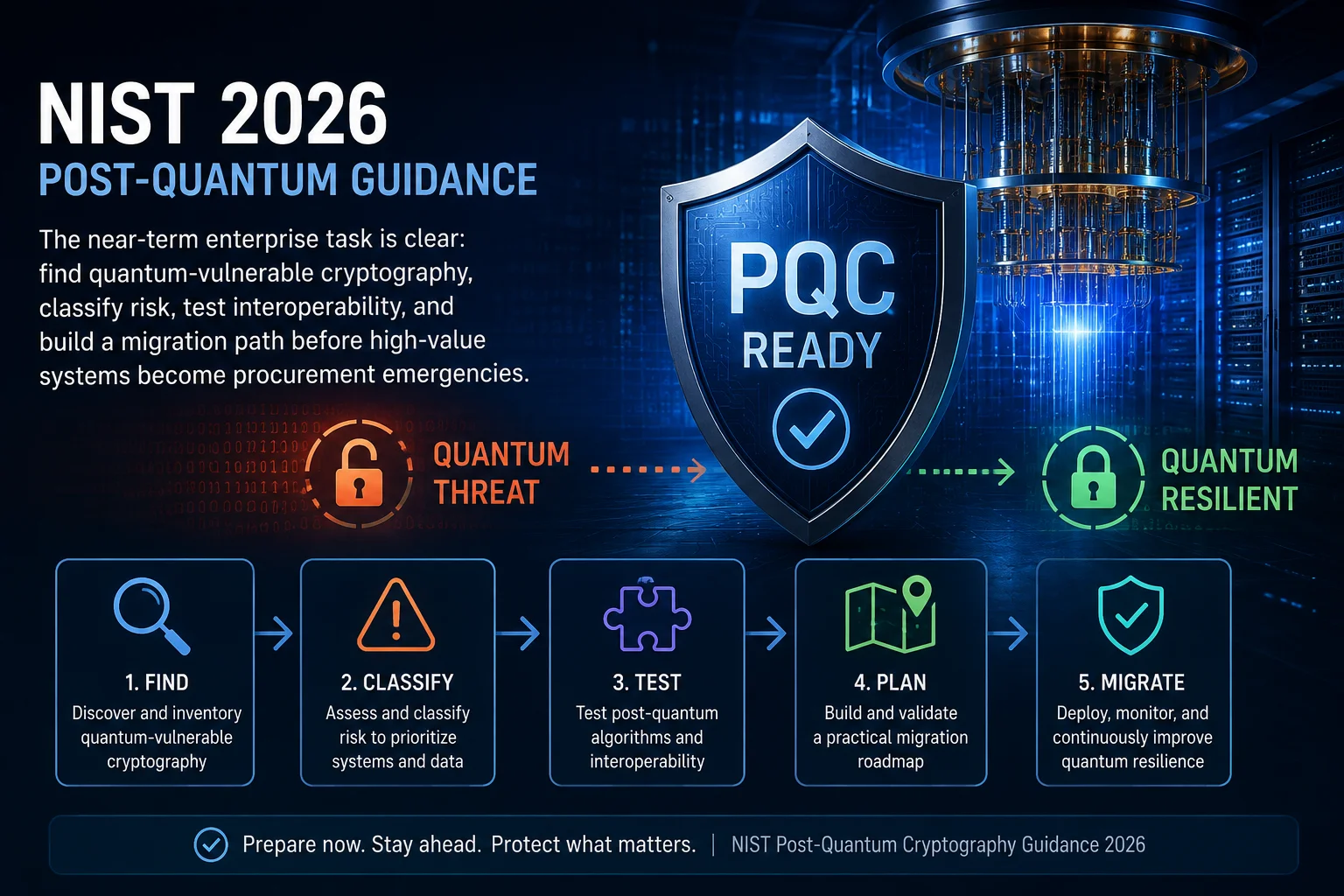
A practical 12-month plan
Enterprises do not need a dramatic rewrite to begin. They need a disciplined program.
First, build a cryptographic inventory across externally exposed services, internal service-to-service traffic, identity systems, code-signing workflows, PKI, VPNs, backup encryption, and regulated data stores. Tie each finding to an owner and business function.
Second, classify risk. Prioritize systems that protect long-lived confidential data, high-value assets, signing infrastructure, privileged access, and dependencies shared across many applications.
Third, define reference architectures. Decide how the organization will handle hybrid key establishment, certificate issuance, library versions, HSM support, logging, monitoring, and rollback.
Fourth, run interoperability pilots. Use representative clients, real certificates, actual load balancers, and normal observability paths. Measure both security and operational behavior.
Fifth, update procurement and software standards. Require vendors to document PQC support, algorithm agility, and dependency timelines.
Finally, review progress as part of normal infrastructure governance. PQC should not be a once-a-year security presentation. It should become part of platform engineering, certificate management, and architecture review.
The enterprise takeaway
Post-quantum cryptography is not waiting for quantum computers to appear in a data center. It is already a migration problem because cryptography is embedded deeply in enterprise systems, and replacing it will take years. The organizations that start with inventory, interoperability, and crypto agility will be able to move deliberately. The organizations that wait for an emergency deadline will discover that their hardest dependency was not a cryptographic algorithm. It was the lack of a map.