Summary
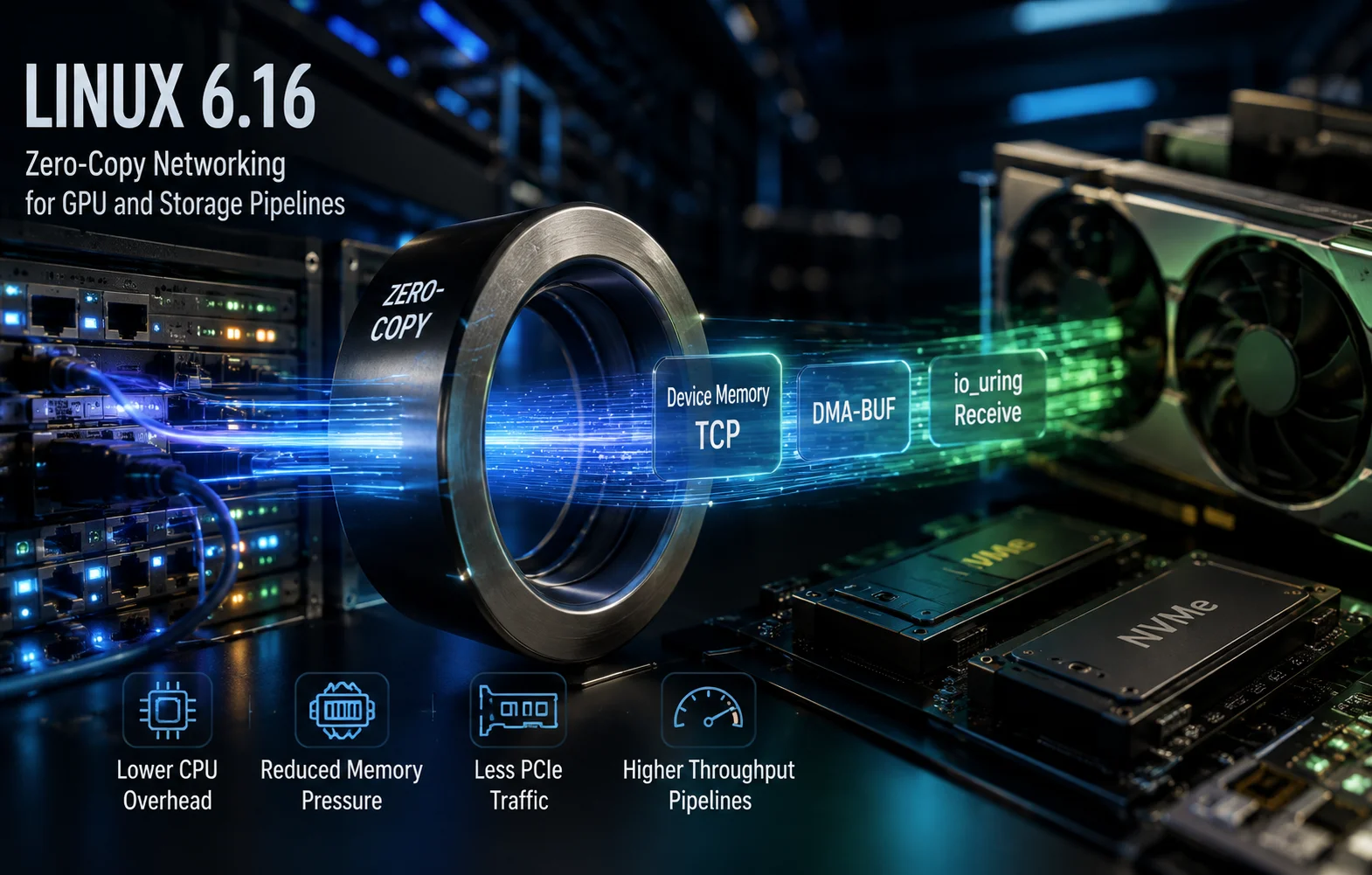
Linux 6.16 is not a single-feature performance release, but it moves several important data-path ideas closer to production relevance. The most interesting change for infrastructure teams is the continued maturation of zero-copy networking around Device Memory TCP, DMA-BUF, and io_uring zero-copy receive. In practical terms, the kernel is gaining more ways to move TCP payloads between NICs, user space, and device memory without repeatedly bouncing large buffers through host memory.
That matters because many modern server workloads are no longer primarily limited by scalar CPU execution. AI inference services, distributed training jobs, high-throughput object stores, software-defined storage nodes, and telemetry pipelines can spend significant time and energy moving bytes between a NIC, DRAM, PCIe devices, and accelerators. Linux 6.16 does not eliminate that cost by itself, and most enterprises should not expect a simple kernel upgrade to accelerate arbitrary applications. What it does provide is a stronger upstream foundation for applications and platforms that are willing to manage buffers deliberately.
Why the Linux Data Path Is Under Pressure
For years, the default server assumption was simple: packets arrive at the NIC, the kernel handles TCP/IP, data lands in host memory, and applications copy or transform it as needed. That model is robust, debuggable, and general-purpose. It is also increasingly expensive for pipelines where the host CPU is not the final consumer of the data.
Consider an AI inference node that receives request payloads, pushes embeddings or tensors toward a GPU, and returns generated output over the network. Or a storage service that receives large blocks over TCP and writes them to local NVMe. In both examples, the traditional path may involve multiple copies across host memory and repeated traversal of shared interconnects. Each copy consumes memory bandwidth. Each trip through the PCIe root complex can add pressure to links that are already shared by NICs, GPUs, NVMe drives, and CXL devices.
At rack scale, this is not just a micro-optimization. Memory bandwidth, PCIe topology, NUMA locality, and interrupt behavior can determine whether a server platform delivers predictable latency under load. The kernel community has been addressing this from several directions: io_uring for lower-overhead asynchronous I/O, DMA-BUF for sharing buffers across device and subsystem boundaries, and networking changes that let payloads land closer to where they will be processed.
What Linux 6.16 Adds
The Linux 6.16 release summary lists several features relevant to high-performance systems, including Device Memory TCP transmit support, io_uring updates, XFS large atomic writes, ext4 performance work, futex improvements, and automatic weighted interleaved memory allocation policy. The networking and io_uring pieces are the ones that form a coherent story for data-heavy infrastructure.
Device Memory TCP was introduced earlier on the receive side to allow TCP payloads to be received directly into DMA-BUF-backed memory. Linux 6.16 adds the transmit side for zero-copy sending of TCP payloads from DMA-BUF memory. The kernel documentation describes the intended use cases directly: distributed training where accelerators on different hosts exchange data, and distributed raw block storage applications that move large amounts of data that may not require host processing.
Separately, io_uring zero-copy receive allows packet data to be received directly into user-space memory while the kernel still processes packet headers through the normal TCP stack. Linux 6.16 also brings DMA-BUF support into that io_uring zero-copy receive path, according to contemporary kernel coverage and the upstream documentation. That combination is important because it ties modern asynchronous application I/O to a buffer-sharing mechanism already used across Linux drivers and device subsystems.
The Architecture Shift: Keep Control, Remove Avoidable Copies
Zero-copy networking is often discussed as if the objective were to bypass the operating system entirely. That is not the interesting part of this Linux work. Kernel bypass frameworks can deliver excellent throughput in specialized environments, but they also change the operational model. Teams must handle polling, isolation, packet steering, observability, security boundaries, and failure behavior differently from normal Linux networking.
The Device Memory TCP and io_uring approach is more incremental. Packet headers can still be processed by the Linux TCP/IP stack. The application still uses Linux APIs. The change is that payload buffers can be placed more deliberately, including into memory represented by DMA-BUF. That keeps more of the standard Linux networking model intact while reducing unnecessary payload movement for applications designed to participate in the model.
This distinction matters for enterprises. Most organizations are not eager to rebuild their platform around a completely separate packet-processing environment unless the workload justifies it. A kernel-native path that preserves TCP semantics, integrates with existing NIC configuration, and can be adopted by selected applications is easier to pilot.
Operational Requirements Are Not Optional
The tradeoff is complexity. The upstream documentation is clear that io_uring zero-copy receive depends on NIC capabilities and explicit configuration. Header/data split is required so packet headers can go to kernel memory while payloads go directly to the configured target. Flow steering is required so selected flows land on the hardware queues prepared for zero-copy receive. RSS must steer ordinary traffic away from those queues.
That means this is not a generic sysctl tuning exercise. A serious deployment needs compatible NICs, driver support, queue planning, ethtool configuration, application changes, and observability around fallbacks. If traffic misses the intended queue, if the NIC cannot split a packet as required, or if the application does not recycle buffers correctly, the workload can lose the expected benefit or fail in less obvious ways.
The Device Memory TCP documentation also lists caveats that should be read before any production pilot. Payloads in device memory are not readable by the kernel in the usual way. Loopback is not functional for those payloads. Software checksum calculation fails. Tools such as tcpdump and BPF cannot inspect the device-memory packet payload. For security and operations teams, that changes how packet-level troubleshooting and monitoring must be designed.
Where This Could Matter First
The earliest practical adopters are likely to be platforms where the data path is already custom and the operational team controls the full stack. AI clusters are an obvious candidate. When GPUs on different hosts exchange large volumes of tensor data, avoiding extra host-memory copies can reduce pressure on CPU sockets and memory channels. The gain is not only throughput; it may also reduce CPU overhead and improve latency consistency when the host is otherwise busy scheduling inference or orchestration tasks.
High-throughput storage systems are another plausible target. A service receiving large blocks over TCP and placing them on NVMe does not necessarily need the host CPU to inspect every byte of payload. Linux 6.16 also includes block-layer work such as NVMe Flexible Data Placement block write stream support and XFS large atomic writes, which points to a broader kernel theme: giving storage-aware software more control over placement, ordering, and failure semantics.
Network appliances and telemetry collectors may benefit later, but they face a tougher observability tradeoff. If packet payload inspection is central to the product, moving payloads into places the kernel cannot easily inspect may complicate debugging and policy enforcement. Those environments will need careful separation between flows that benefit from zero-copy placement and flows that require conventional inspection.
What CTOs and Platform Teams Should Do Now
The immediate action is not to roll Linux 6.16 everywhere. Enterprise distributions will backport, stabilize, or omit features according to their own support models. Hardware enablement will vary. Application frameworks need time to expose these capabilities cleanly.
A better approach is to identify one or two byte-heavy services where copies are measurable bottlenecks. Baseline CPU utilization, memory bandwidth, PCIe counters, NIC queue behavior, p99 latency, and throughput before changing anything. Then evaluate whether the application can reasonably adopt io_uring or Device Memory TCP APIs, whether the NICs support the required features, and whether operations can tolerate the observability changes.
Teams should also map the physical topology. On dense accelerator servers, it matters which NIC is closest to which GPU or NVMe device. A zero-copy design that looks clean in software may still perform poorly if traffic crosses an overloaded interconnect or lands on the wrong NUMA node. Linux 6.16's automatic weighted interleaved memory policy is another sign that memory topology is becoming more visible to mainstream kernel behavior, but locality planning remains a platform engineering responsibility.
The Enterprise Readout
Linux 6.16 makes zero-copy networking more practical, not automatic. The release strengthens the upstream path for direct movement of payloads between the network and device-oriented buffers, especially through Device Memory TCP, DMA-BUF, and io_uring. For general web services, the impact may be negligible. For GPU pipelines, storage services, and other byte-intensive systems, it is a signal that Linux is adapting to architectures where moving data can be more expensive than computing on it.
The correct lens is infrastructure optionality. Enterprises do not need every application to use these interfaces. They need a supported, kernel-native way for the most demanding services to reduce avoidable data movement without abandoning Linux's operational model. Linux 6.16 is a meaningful step in that direction, provided teams treat it as an engineering project rather than a checkbox upgrade.