Summary
Rack-scale AI systems are changing the scheduling problem for infrastructure teams. A GPU cluster can no longer be treated as a flat pool of interchangeable accelerators when the most expensive hardware is wired into high-bandwidth islands such as NVLink domains, multi-node NVLink fabrics, and topology-specific memory paths. The operational challenge is to expose enough of that structure to Slurm, Kubernetes, and platform users without making every model team understand the physical rack.
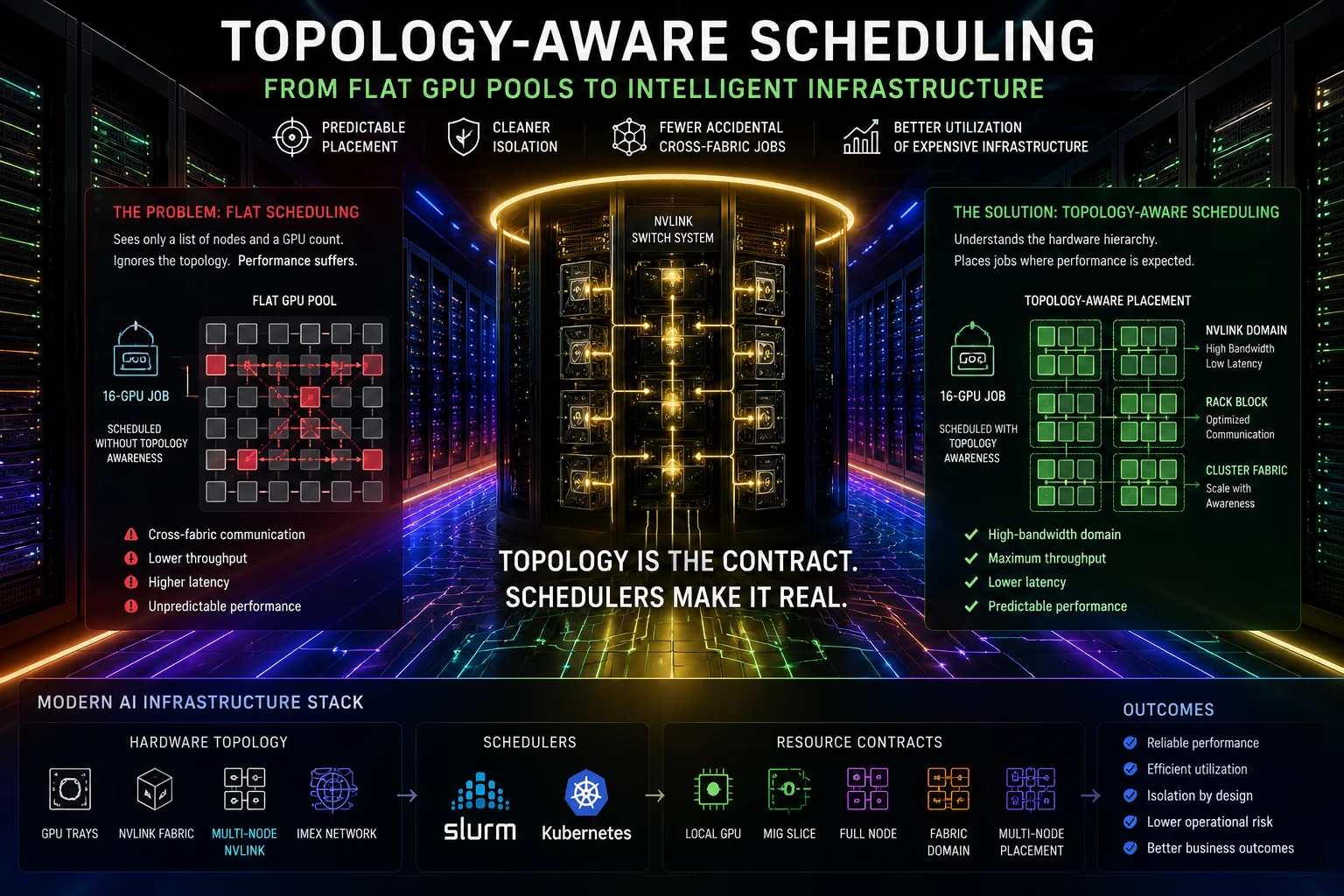
Recent NVIDIA guidance around GB200 and GB300 NVL72 systems, Kubernetes Dynamic Resource Allocation, and traditional Slurm topology controls points toward a practical pattern: topology must become an explicit resource contract. The goal is not merely higher benchmark numbers. It is predictable placement, cleaner isolation, fewer accidental cross-fabric jobs, and better utilization of infrastructure that may be power- and capital-constrained before it is compute-constrained.
Why rack-scale AI breaks flat scheduling assumptions
For many years, accelerator scheduling was simple enough to describe as a count. A job requested four GPUs, eight GPUs, or a full node, and the scheduler matched that request against available capacity. That model works reasonably well when accelerators are attached to a single host or when cross-node communication is limited. It becomes fragile when the system is built around a rack-level fabric where placement determines whether a distributed model stays inside a high-bandwidth domain or spills into a slower path.
The new rack-scale systems combine dense compute trays, high-bandwidth GPU interconnects, specialized network paths, and control-plane software that understands physical relationships. NVIDIA describes GB200 NVL72 and GB300 NVL72 systems as tightly coupled rack-scale supercomputers built around NVLink switches, Multi-Node NVLink, and IMEX-capable compute trays. The important point for operators is not the brand name of the fabric; it is that the fabric is hierarchical. Some GPUs are close. Some are farther away. Some groups can share high-bandwidth, low-latency paths that other groups cannot.
If the scheduler sees only a list of nodes and a scalar GPU count, it can place a 16-GPU training or inference job across resources that satisfy the numeric request but violate the performance intent. A workload that expects all-to-all communication inside a coherent high-bandwidth domain may still run, but with lower throughput, more tail latency, and less predictable interference with neighboring jobs. That can look like an application problem even though the root cause is placement.
The enterprise issue is predictability, not peak speed
AI infrastructure buyers often focus on peak throughput claims, but platform teams live with day-two variance. A model that performs well in a controlled validation run can behave differently when the cluster is shared across training, fine-tuning, batch inference, interactive inference, data processing, and evaluation workloads. Small placement differences can become large operational differences when jobs depend on expert parallelism, collective communication, remote memory access, or large KV-cache movement.
That is why topology-aware scheduling should be evaluated as a reliability feature as much as a performance feature. It reduces the number of hidden variables between a workload specification and the hardware it receives. When the scheduler can represent an NVLink partition, a rack block, a device class, or a compute domain, the platform can define policy in infrastructure terms: keep latency-sensitive inference inside one fabric island, reserve broader spanning placements for jobs that tolerate the tradeoff, and avoid spreading tightly coupled jobs just because idle devices exist elsewhere.
This is especially relevant for multi-tenant enterprise AI platforms. A central platform team may operate the physical cluster, while different business units submit workloads through Slurm, Kubernetes, an internal developer portal, or a managed AI platform. Users should not need to know every switch, rack, and device identifier. They do need a stable contract that tells them whether they are asking for a local GPU, a MIG slice, a full node, a multi-node fabric domain, or a larger placement with explicit performance tradeoffs.
Slurm already has a language for locality
Slurm has long supported topology-aware resource allocation. Its topology guide explains that without a topology plugin, native resource selection treats nodes as a one-dimensional array and allocates them on a best-fit basis. With topology plugins, Slurm can use hierarchical network information to minimize contention and place jobs closer together where possible.
That model maps naturally to traditional HPC clusters, where network hierarchy has always mattered. The lesson for AI infrastructure is that scheduling locality is not new; what is new is the density and economic importance of the accelerator fabric. In a GPU rack where each domain may represent a large fraction of total platform value, a placement mistake is more expensive than a suboptimal CPU job allocation.
For Slurm environments, the practical work is to maintain topology data, expose meaningful partitions or blocks, and align queue policy with hardware reality. Administrators need to decide which jobs can span domains, which should wait for local placement, and which should be constrained by user, project, or service class. The hard part is not enabling a feature flag. It is building a policy model that reflects the cost of breaking locality.
Kubernetes DRA changes the device request contract
Kubernetes is approaching the same problem from a different direction. Dynamic Resource Allocation, now documented as a stable Kubernetes feature, allows device drivers and cluster administrators to define device classes, resource claims, and resource slices. Instead of only asking for an integer count of an opaque extended resource, a workload can reference a claim that selects devices based on attributes and driver-provided capabilities.
That matters because modern accelerators are not fungible. Operators may need to distinguish GPU model, memory capacity, MIG profile, attachment path, fabric membership, or vendor-specific configuration. Kubernetes DRA provides a framework for pushing richer resource information into scheduling decisions while giving workload authors a cleaner interface than hand-maintained node labels and selectors.
The key architectural shift is that device allocation becomes closer to storage provisioning. A workload claims a class of resource, the scheduler matches that claim against published resource slices, and the driver prepares the device for use. This does not eliminate operational complexity, but it moves it into explicit APIs and driver contracts rather than informal labeling schemes.
Compute domains are the missing abstraction for multi-node GPUs
For single-node GPU allocation, DRA can improve selection and sharing. For rack-scale AI, the more important idea is the compute domain. NVIDIA’s DRA documentation describes ComputeDomains as an abstraction for robust and secure Multi-Node NVLink on systems such as GB200. In plain terms, the platform needs a way to allocate not just devices, but a set of devices that are connected in the right way.
That distinction is critical. A distributed model does not merely consume eight arbitrary accelerators. It consumes a communication pattern, memory movement budget, and failure domain. When compute domains are represented directly, a scheduler can bind the participating pods or tasks to nodes that share the required fabric. The platform can also tear down the domain when the workload ends, reducing the risk of stale reservations or accidental sharing.
This is where Kubernetes, Slurm, and vendor control planes begin to converge. The scheduler needs accurate topology data. The workload needs a portable way to request the right class of hardware. The operator needs policy, observability, and guardrails. Without all three, topology awareness becomes either too manual or too invisible to trust.
What platform teams should inventory now
Before buying more accelerators, enterprise teams should inventory the topology information they can actually use. That includes node-to-switch relationships, GPU-to-GPU connectivity, NVLink or equivalent domains, high-performance network paths, NUMA layout, storage proximity, power domains, and cooling constraints. It also includes software support: Slurm plugins, Kubernetes DRA support, GPU operator versions, container runtime configuration, and telemetry that can correlate placement with performance.
The inventory should be tested with real workloads, not only hardware diagrams. A short benchmark that exercises collective communication, prefill/decode separation, checkpoint I/O, or multi-node inference can reveal whether the scheduler is honoring locality. Operators should capture placement metadata with job metrics so application teams can distinguish model regressions from infrastructure placement differences.
Risks and implementation tradeoffs
Topology-aware scheduling can also create fragmentation. If every job insists on ideal placement, utilization may fall because the scheduler waits for perfect domain availability while other devices sit idle. Enterprises need policies that distinguish hard constraints from preferences. Latency-sensitive serving may require strict placement. Opportunistic batch jobs may accept broader placement. Development workloads may be routed to smaller or less expensive classes.
There is also a portability issue. A topology abstraction that exactly mirrors one vendor’s rack can become difficult to reuse across hardware generations. The better approach is to define service-level classes: single-node accelerator, local multi-GPU node, rack-local high-bandwidth domain, cross-rack distributed placement, and so on. Under the hood, each class can map to the specific hardware available in that environment.
Security and isolation must be part of the design. Shared accelerator fabrics, remote memory features, and multi-tenant GPU platforms require careful boundaries. Allocation APIs should make it clear when a workload receives exclusive access, shared access, or a partitioned resource. Telemetry and audit logs should show which users and jobs occupied which domains at which times.
The bottom line
Rack-scale AI infrastructure makes physical topology a first-class operational concern. Slurm, Kubernetes DRA, and vendor tools are moving toward the same conclusion: accelerator scheduling must describe more than counts. It must describe locality, fabric membership, device attributes, and policy.
For CTOs and infrastructure architects, the immediate task is not to chase every new control-plane product. It is to ensure that the platform can express the hardware’s real constraints in scheduling decisions. The organizations that do this well will not simply run faster jobs. They will get more predictable service levels from expensive infrastructure, reduce waste caused by poor placement, and give application teams a clearer contract for production AI workloads.